From Distraction to Direction: Building the Habit of Deep, Sustained Attention
From my last two articles in this segment, you now understand why rest is essential for peak performance and how achieving a state of flow with gamma brainwaves unlocks your brain's highest-performance mode. But here's the critical piece: How do you sustain attention over time and manage the relentless distractions that pull you off course?

Single moments of flow are valuable, but the ability to return to deep focus repeatedly, day after day, separates exceptional performers from the rest. This requires building "attention stamina," strengthening your "focus muscle" so sustained concentration becomes habitual rather than exhausting.
How to Manage Digital Distractions for Deep Work
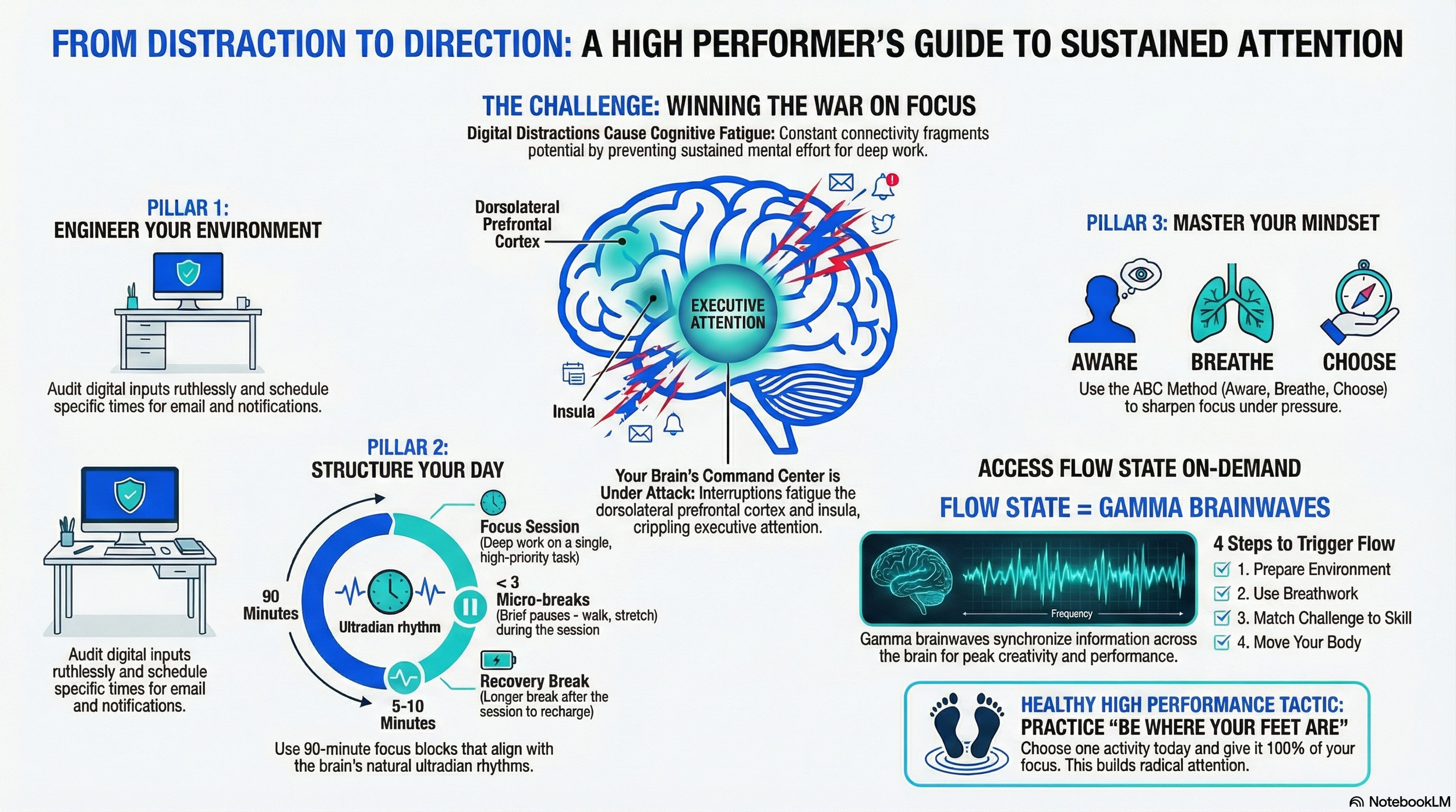
We live in constant connectivity, and it's destroying our capacity for deep work. Notifications, emails, and social media create cognitive fatigue: a failure to sustain attention and optimize performance during sustained mental effort.
The solution isn't abandoning technology but using it intentionally. Audit your inputs ruthlessly. Remove podcasts, books, and social media that don't move you forward. Turn off notifications. Schedule specific email times rather than reacting to every message. When focusing, put devices out of sight.
Research shows that the dorsolateral prefrontal cortex (involved in decision making) and insula (involved in evaluating rewards) are particularly sensitive to cognitive fatigue [1]. Constant digital interruptions prevent your prefrontal cortex from sustaining the executive attention needed for complex work [2].
Building Mental Resilience for Focus Under Pressure
When pressure increases, attention narrows. Elite performers use this. Blue Angels pilot John Foley describes flying at high speed: "You’re so focused that it’s very calm. And you aren’t thinking at all. If you are thinking, you are dead. But because you trained and focused, you can execute at the highest imaginable level".
The key is training yourself to expect pressure and sharpen rather than scatter your focus. Use the ABC method: be Aware of your options, Breathe to consider them, and Choose where to direct your attention.
Mindfulness training builds the mental muscles required to control attention. It strengthens alerting, orienting, and executive control networks in the brain, all critical for sustained mental performance [3], [4].
Daily Focus Habits: The Power of Routine
Daily focus habits build cumulative strength. Consistent routines reduce decision fatigue by providing structure. When you don't have to decide what to do next, you free mental resources for meaningful work.
Routines strengthen executive functioning by helping the brain manage tasks efficiently through structured cues and predictability. Over time, repeated patterns become automatic, leveraging neuroplasticity to make sustained focus feel less effortful.
Build a morning routine by deciding your most important task the night before. Do it first, when your prefrontal cortex is fresh. Based on research suggesting that we have similar ~90-minute “ultradian” rhythms similar to our REM sleep cycles, schedule 90-minute blocks for focused execution [5].
For tasks that are cognitively demanding, take strategic microbreaks (less than 3 minutes) every 20-30 minutes and take longer breaks of 5-10 minutes every 60-90 minutes. Walk, stretch, or gaze out a window. Research shows that these brief pauses prevent cognitive fatigue and maintain performance across the day [5], [6].
Getting Into Gamma: How to Access Flow State Consistently
Flow doesn't happen by accident. Here are practical techniques:
· Prepare your environment. Eliminate distractions ruthlessly. Close unnecessary tabs. Put your phone in another room. Create sacred space for deep work.
· Use breathwork to regulate arousal. Box breathing (inhale 4, hold 4, exhale 4, hold 4) calms your nervous system and creates the calm alertness that precedes flow.
· Match challenge to skill. Flow exists where the task stretches but doesn't overwhelm your abilities. Too easy and you're bored; too hard and you're anxious.
· Exercise before cognitively demanding work. A 15-minute walk, jog, or bike ride energizes your mind and improves sustained attention.
· Practice present-moment awareness. Notice thoughts, sensations, sounds, and smells without judgment. Choose an anchor (your breath, feet on ground) and return to it when your mind wanders.
The Path to Deep Focus and Sustained Attention
From this series, you've learned three critical insights:
1. Rest is the foundation of performance. Stress plus rest equals growth.
2. Gamma brainwaves create flow by synchronizing information across brain regions, enabling peak creativity and performance.
3. Sustained attention is trainable. By managing digital distractions, building mental resilience, establishing daily routines, and optimizing flow access, you strengthen your capacity for deep focus.
Now, with your attention stamina strengthened, you're ready for the next frontier: applying focus and flow to truly master any skill. In our next series, we'll explore how metacognition and strategic learning accelerate expertise and unlock your full potential.
1% TIP: PRACTICE "BE WHERE YOUR FEET ARE"
Whatever you're doing, wherever you are, make sure your head and heart are completely there too. In conversation, focus only on what the other person is saying. When working, commit fully to the task. This practice of being completely present in the moment builds your capacity for radical attention. Choose one activity today and give it 100% focus for its entire duration.
References
[1] G. Steward, V. Looi, and V. S. Chib, “The Neurobiology of Cognitive Fatigue and Its Influence on Effort-Based Choice,” J. Neurosci., vol. 45, no. 24, p. e1612242025, Jun. 2025, doi: 10.1523/JNEUROSCI.1612-24.2025.
[2] D. Krabbe, S. Ellbin, M. Nilsson, I. H. Jonsdottir, and H. Samuelsson, “Executive function and attention in patients with stress-related exhaustion: perceived fatigue and effect of distraction.,” Stress, vol. 20, no. 4, pp. 333–340, Jul. 2017, doi: 10.1080/10253890.2017.1336533.
[3] S. Ehmann, I. Sezer, A. S. Keller, I. N. Treves, and M. D. Sacchet, “Attention and meditative development: A review and synthesis of long-term meditators and outlook for the study of advanced meditation.,” Neuroimage, vol. 323, p. 121602, Nov. 2025, doi: 10.1016/j.neuroimage.2025.121602.
[4] A. Calderone et al., “Neurobiological Changes Induced by Mindfulness and Meditation: A Systematic Review.,” Biomedicines, vol. 12, no. 11, Nov. 2024, doi: 10.3390/biomedicines12112613.
[5] N. Kleitman, “The Basic Rest — Activity Cycle BT - The Nervous System and Electric Currents: Proceedings of the Third Annual National Conference of the Neuro-Electric Society, held in Las Vegas, Nevada, March 23–25, 1970,” N. L. Wulfsohn and A. Sances, Eds., Boston, MA: Springer US, 1970, p. 133. doi: 10.1007/978-1-4684-1836-1_21.
[6] T. McMorris, M. Barwood, B. J. Hale, M. Dicks, and J. Corbett, “Cognitive fatigue effects on physical performance: A systematic review and meta-analysis,” Physiol. Behav., vol. 188, pp. 103–107, 2018, doi: https://doi.org/10.1016/j.physbeh.2018.01.029.