Emotional Regulation: Your Breath Holds the Key
The world is dysregulated. A flash of panic before a presentation. A wave of anger during an argument. An anxious spiral at 3 a.m. In each of these moments, one deep breath can shift everything. That's not wishful thinking. It's physiology. Your breath is the master tool for taking control of your nervous system, and most people don’t realize they already have everything they need for developing emotional regulation skills.

The Mental Health and Stress Dysregulation Crisis
We are living through an epidemic of chronic stress. According to the World Health Organization, global rates of anxiety and depression increased by 25% during the first year of the COVID-19 pandemic alone. Generation Z reports unprecedented levels of mental health concerns, with a 2023 APA report finding they are “completely overwhelmed” by stress, including both financial worries and social isolation. In Canada, a 2023 report found 23% of teens transitioning to adulthood reported a decline in their mental health.
Most people believe emotions simply happen to them. They feel anxious and assume they must wait for the anxiety to pass. They feel overwhelmed and believe they have no control. But the truth is different: you can directly influence your emotional state by simply changing how you breathe.
How Your Nervous System Controls Stress and Regulates Emotions
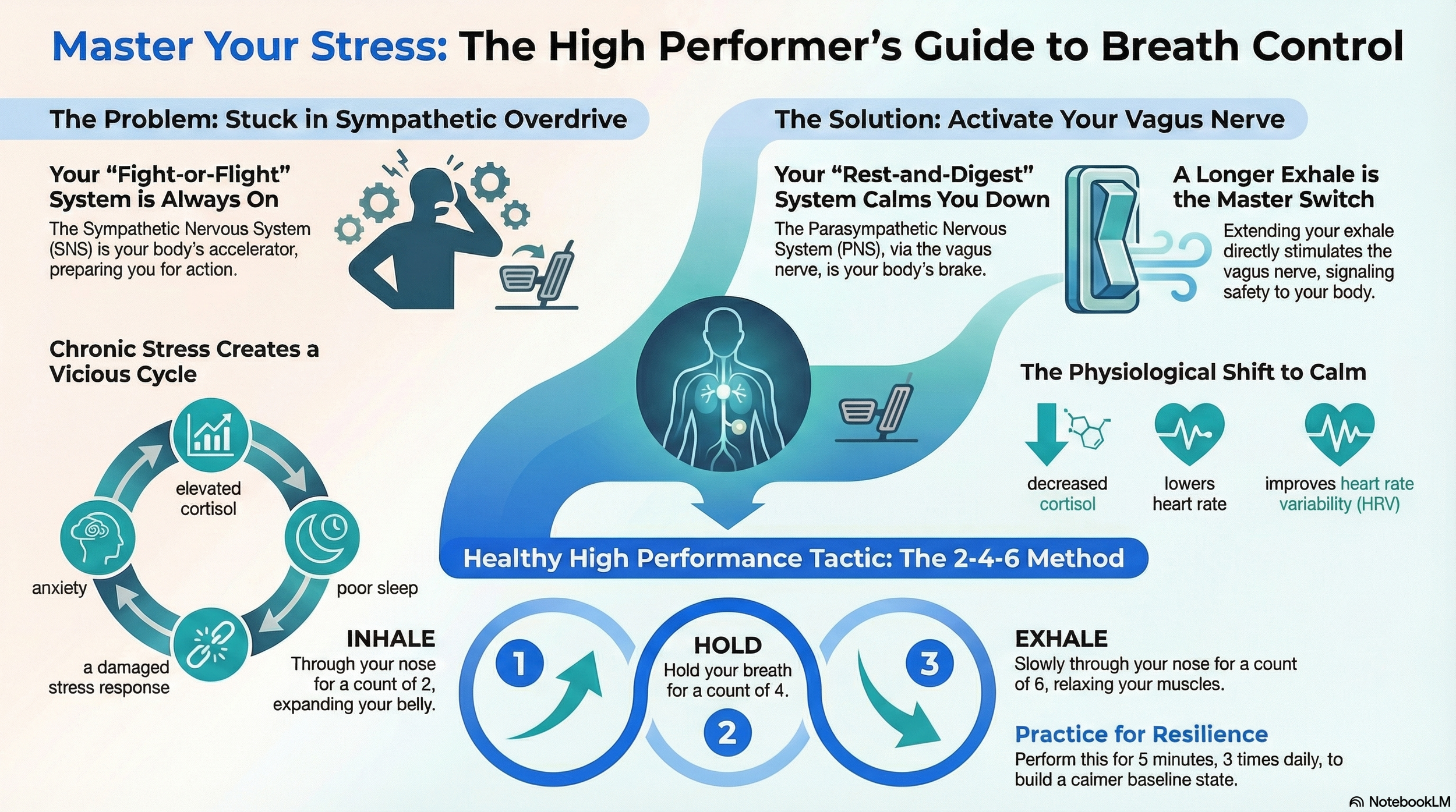
Your autonomic nervous system operates in two primary modes. The sympathetic nervous system (SNS) is your activation system that activates the "fight, flight, freeze or fawn" response to mobilize energy for action or survival. The parasympathetic nervous system (PNS) is your recovery system, the "rest and digest" response that calms you down, restores balance, and promotes healing.
When stress becomes chronic, we get stuck in sympathetic overdrive. Heart rate stays elevated. The stress hormone, cortisol, floods the system promoting weight gain and suppressing your immune system. Sleep deteriorates. Anxiety becomes the baseline. Worse, prolonged cortisol exposure damages the hippocampus, the brain region that helps regulate and shut down the stress response, creating a vicious cycle of dysregulation [1].
The key to breaking this cycle is learning how to deliberately shift from sympathetic to parasympathetic activation. And the fastest, most accessible way to do that is through your breath.
The Vagus Nerve: Your Master Switch for Calm
The vagus nerve is the main pathway of the parasympathetic nervous system. It connects your brain to your heart, lungs, and digestive system, influencing heart rate, digestion, mood, and inflammation. When the vagus nerve is stimulated, your heart rate slows, blood pressure drops, heart rate variability improves and a cascade of calming signals flows through your body [2].
Here's the crucial insight: you can deliberately stimulate your vagus nerve through breathing [2], [3].
During inhalation, vagal influence momentarily decreases and heart rate rises slightly. During exhalation, vagal outflow is restored and heart rate slows [4]. This is why extending your exhale is the fastest way to calm your nervous system. When you breathe out longer than you breathe in, you directly activate the parasympathetic response and signal safety to your brain and body.
Research demonstrates that even a single session of slow, deep breathing with extended exhalation can decrease cortisol levels, lower heart rate, and increase parasympathetic activity [3], [4], [5].
Breathing Changes Your Brain Chemistry and Mental Health
More than just calming you down, deep, controlled breathing changes the neurochemical environment of your brain. Slow breathing increases oxygen delivery to the brain, enhancing cognitive function, and reducing anxiety. It also shifts the balance between cortisol and GABA (gamma-aminobutyric acid), the calming neurotransmitter targeted by anti-anxiety medications [6]. Deep, slow breathing also increases alpha waves, which we know from my previous articles are tied to a sense of calm and relaxation [7]. This is your nervous system’s most accessible super-power—a neurochemical reset available to you anytime, anywhere, through the simple biology of breath.
A study from Boston University found that a 12-week intervention combining yoga postures and coherent breathing significantly reduced depressive symptoms and increased brain GABA levels [6]. This finding suggests that behavioral interventions like breathwork can produce neurochemical changes comparable to pharmaceuticals.
Athletes, soldiers, and high performers have long used breathwork to regulate emotions under pressure. Navy SEALs use "box breathing" (inhale for 4 counts, hold for 4, exhale for 4, hold for 4) to stay calm during combat operations. Olympic athletes use controlled breathing to manage pre-competition anxiety and access peak performance states.
With practice, you can shift from panic to calm in two to three minutes using simple deep, slow breathing techniques. But that's just the foundation. Powerhouse unlocks the full power of your breath: energizing techniques to ignite focus and drive, concentration practices that sharpen your mind under pressure, and advanced protocols used by elite athletes and performers to access peak states on demand.
Up Next
This article introduced the foundational science of breath-based emotional regulation: the sympathetic and parasympathetic nervous systems, the vagus nerve, and how controlled breathing changes both your physiology and brain chemistry. In the next article, we'll go deeper how to leverage breathwork in combination with hot and cold therapies to boost energy and performance throughout the day.
1% TIP: MASTER THE 2-4-6 RATIO FOR INSTANT CALM, LASTING RESILIENCE
The single most powerful adjustment you can make to your breathing is to exhale longer than you inhale. Try a simple 2:4:6 technique: get in a relaxed position, sitting comfortably or laying down. Inhale through your nose for 2 counts, expanding your belly. Then hold for 4 counts, and exhale slowly through your nose for 6 counts, relaxing all your muscles as you exhale. This form of breathing is called Pranayama and has been used for centuries for relaxation and resetting the nervous system. Make sure you are breathing in and out through your nose—research shows that nasal breathing during rest resulted in marked improvements in heart rate variability and blood pressure over breathing through your mouth [8].
Practice this breathing for 5 minutes, three times daily—in the morning, at midday, and before bed. See if you can work your way up to longer sessions (10 or 20 minutes). Over time, your nervous system will naturally shift into calmer states more easily, building resilience for the bigger emotional challenges that lie ahead.
References
[1] A. A. Lei et al., “Chronic Stress-Associated Depressive Disorders: The Impact of HPA Axis Dysregulation and Neuroinflammation on the Hippocampus-A Mini Review.,” Int. J. Mol. Sci., vol. 26, no. 7, Mar. 2025, doi: 10.3390/ijms26072940.
[2] C. Lopez Blanco and W. J. Tyler, “The vagus nerve: a cornerstone for mental health and performance optimization in recreation and elite sports,” Front. Psychol., vol. Volume 16-2025, 2025, [Online]. Available: https://www.frontiersin.org/journals/psychology/articles/10.3389/fpsyg.2025.1639866
[3] D. Ma et al., “Benefits From Different Modes of Slow and Deep Breathing on Vagal Modulation.,” IEEE J. Transl. Eng. Heal. Med., vol. 12, pp. 520–532, 2024, doi: 10.1109/JTEHM.2024.3419805.
[4] M. Y. Balban et al., “Brief structured respiration practices enhance mood and reduce physiological arousal.,” Cell reports. Med., vol. 4, no. 1, p. 100895, Jan. 2023, doi: 10.1016/j.xcrm.2022.100895.
[5] A. L. Little, “The A52 Breath Method: A Narrative Review of Breathwork for Mental Health and Stress Resilience.,” Stress Heal. J. Int. Soc. Investig. Stress, vol. 41, no. 4, p. e70098, Aug. 2025, doi: 10.1002/smi.70098.
[6] C. C. Streeter et al., “Thalamic Gamma Aminobutyric Acid Level Changes in Major Depressive Disorder After a 12-Week Iyengar Yoga and Coherent Breathing Intervention.,” J. Altern. Complement. Med., vol. 26, no. 3, pp. 190–197, Mar. 2020, doi: 10.1089/acm.2019.0234.
[7] A. Zaccaro et al., “How Breath-Control Can Change Your Life: A Systematic Review on Psycho-Physiological Correlates of Slow Breathing.,” Front. Hum. Neurosci., vol. 12, p. 353, 2018, doi: 10.3389/fnhum.2018.00353.
[8] J. C. Watso et al., “Acute nasal breathing lowers diastolic blood pressure and increases parasympathetic contributions to heart rate variability in young adults.,” Am. J. Physiol. Regul. Integr. Comp. Physiol., vol. 325, no. 6, pp. R797–R808, Dec. 2023, doi: 10.1152/ajpregu.00148.2023.