Why I’m Doing The Great World Race (7 Marathons on 7 Continents in 7 Days) with my Daughter



In today’s conversation Dr. Greg explores the decision he and his sixteen-year-old daughter Ingrid made to attempt seven marathons on seven continents in seven days. He shares how persistent injuries led them to stop, recover, and rebuild their health from the ground up before they were ready to begin endurance training again. The episode traces the project from a series of small rehabilitation sessions to a potential Guinness World Record attempt, while introducing the Great World Race as a living exploration of human physiology, adaptation, and possibility. The event is scheduled for November 15–21, 2026, beginning at Wolf’s Fang in Antarctica and finishing in Miami.
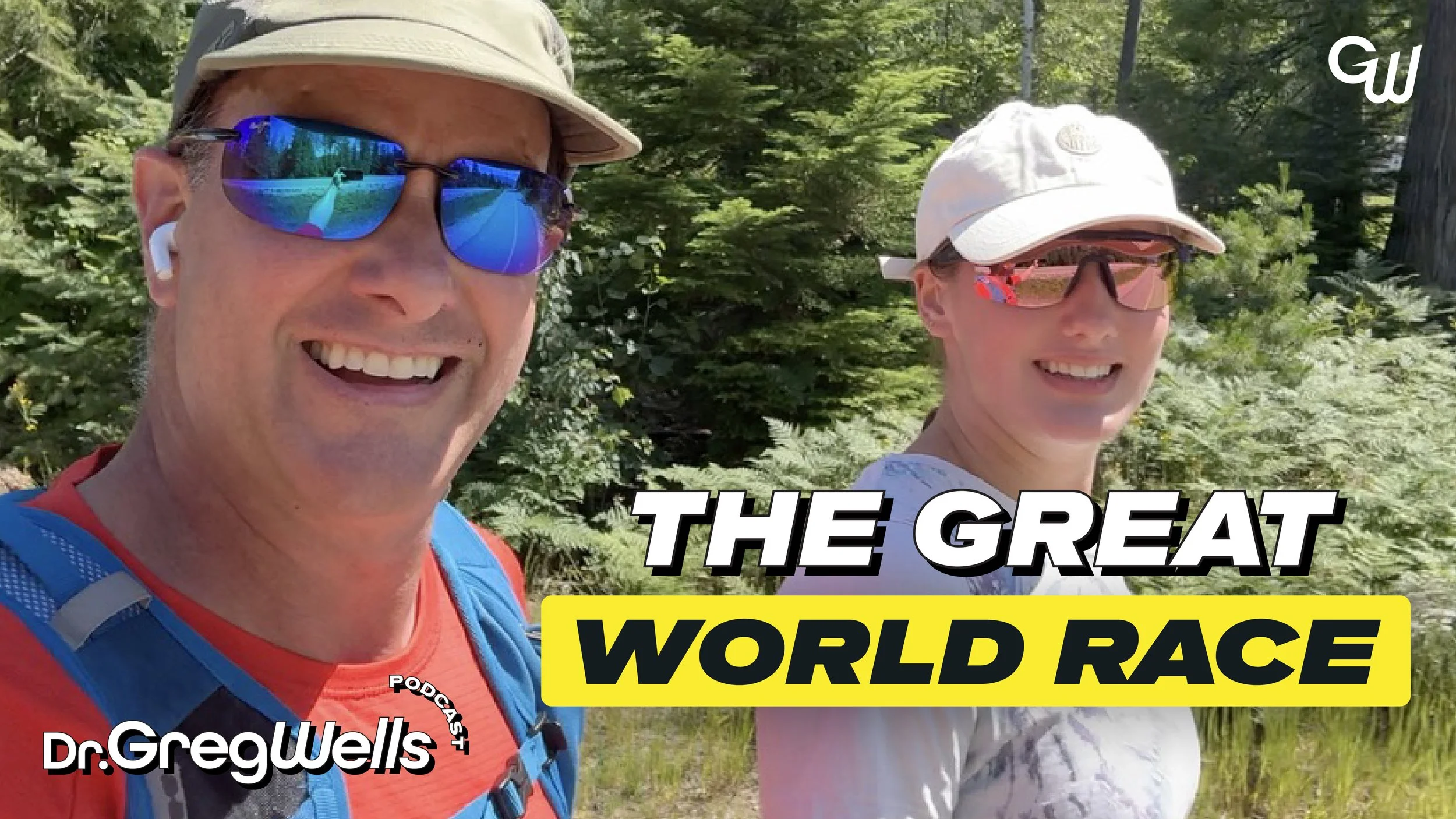
Dr. Greg is addressing the gap between wanting to accomplish something extraordinary and having the physical, mental, and emotional capacity to pursue it safely. Through his and Ingrid’s preparation for the Great World Race, he shows how people can rebuild after injury, pain, fatigue, and lost momentum by returning to the fundamentals, accumulating consistent work, and gradually expanding what their bodies can tolerate.
You will learn why rebuilding capacity sometimes has to come before training for a specific outcome, how consistent strength, mobility, rehabilitation, and recovery helped Greg and Ingrid move beyond persistent pain, and why an ambitious goal can restore direction after a difficult period. You will also learn how Greg approaches seemingly impossible challenges, why 1% improvements remain the foundation of the process, and how physiology can be used to prepare for extreme demands without abandoning health.
You will discover that the first stage of pursuing a major goal may simply be developing enough capacity to begin. Greg describes this as having to “train in order to be able to train,” a process that required months of patient, repetitive work before marathon preparation became possible.
This episode helps solve the challenge of feeling physically stuck or discouraged after injury, illness, fatigue, or an extended period away from training. It offers a way forward based on rebuilding the foundation, respecting the body’s current capacity, and allowing confidence to return through repeated evidence of progress.
Key take aways:
Build capacity before adding intensity.
Small actions prepare you for massive goals.
Recovery requires patience and repetition.
Big dreams can restore direction.
Do hard things with people you love.
“It’s almost like we had to train in order to be able to train.”
Today Is A In-Between Episode with Dr. Greg Wells
Dr. Greg Wells is a human physiologist, scientist, bestselling author, keynote speaker, and founder and CEO of Wells Performance. After breaking and dislocating multiple vertebrae in his neck at age fifteen, he recovered to compete at the Canadian Olympic swimming trials—an experience that led him to study kinesiology and complete graduate training in exercise and respiratory physiology. He later completed postdoctoral fellowships in respiratory medicine at SickKids and biomedical engineering at Toronto General Hospital, and currently serves as a Senior Scientist at the Hospital for Sick Children. He has written five bestselling books and hosted the Gemini Award-winning Superbodies series during the 2010 and 2012 Olympic Games.
Dr. Wells combines laboratory science, clinical research, elite sport, and real-world adventure to study how people build the biological capacity required to perform under pressure. His approach is distinct because he actively stress-tests the principles he teaches, translating physiology into practical strategies for sleep, nutrition, movement, focus, recovery, and adaptation. The 777 Great World Race extends that work into a living laboratory: a father-daughter attempt to complete seven marathons across seven continents while examining what enables the human body and mind to prepare, recover, and continue.
One ACTIONABLE TAKEAWAY: Begin by identifying what your body needs to tolerate before focusing on the final goal. Build that capacity with consistent rehabilitation, mobility, strength, sleep, and recovery, then increase the challenge gradually. A meaningful 1% action repeated daily creates the physiological evidence—and the confidence—needed to attempt something much larger.
This podcast contains advice and information relating to health and wellness. It should be used to supplement rather than replace the advice of your doctor or another trained health professional. If you know or suspect that you have a health problem, seek your physician’s advice before embarking on any medical program or treatment. All efforts have been made to assure the accuracy of the information contained in this podcast / interview / article as of the date of publication. The author and publisher disclaim liability for any medical or other outcomes that may occur as a result of applying the methods suggested in this material.