Food is Medicine: Anti-Inflammatory Eating for Health and Performance
On my way to my first Ironman race, I remember sitting on the bus, thinking about death. Not metaphorical death from exhaustion, but the real kind. A year earlier, I'd been in a cardiac ward with an infected heart. In twelve months, I'd gone from fighting for my life to testing my body's limits. My remarkable recovery wasn't accidental. It came from applying the science of nutrition, sleep, and exercise that aligned with how the body actually heals.
My life had been in overdrive. Balancing a 2-year-old, a wife in grad school, two demanding research jobs, a book launch, media obligations, and a house move left me depleted. Lack of sleep, poor nutrition, and inadequate regular exercise left me fragile. When my daughter caught a cold, my compromised immune system couldn't fight it. The virus hit my heart, causing inflammation. I ended up hospitalized, asking myself the hard questions: how did I get here, and, more importantly, how do I make sure I never come back?
Conversations with nutrition experts led me to a profound realization: the way I ate could determine the trajectory of my recovery. I discovered that eating anti-inflammatory foods accelerates healing while processed foods accelerate disease.
This is the central message I want to share with you in this series: food is medicine.
Inflammation Damages Our Bodies and Minds
Inflammation is a powerful process that, in its acute phase, helps to repair and regenerate the tissues in our bodies and brains. However, if we don’t eat well, if we sleep poorly, don’t exercise and and let stress accumulate unchecked, low-grade inflammation can become chronic, damaging tissues, accelerating aging, and setting the stage for disease. This process is so common that scientists have coined a term for it: inflammaging. The good news is that what you eat can have a direct impact on your inflammatory state, and that comes down to three key principles.
1. Eat More Omega-3s
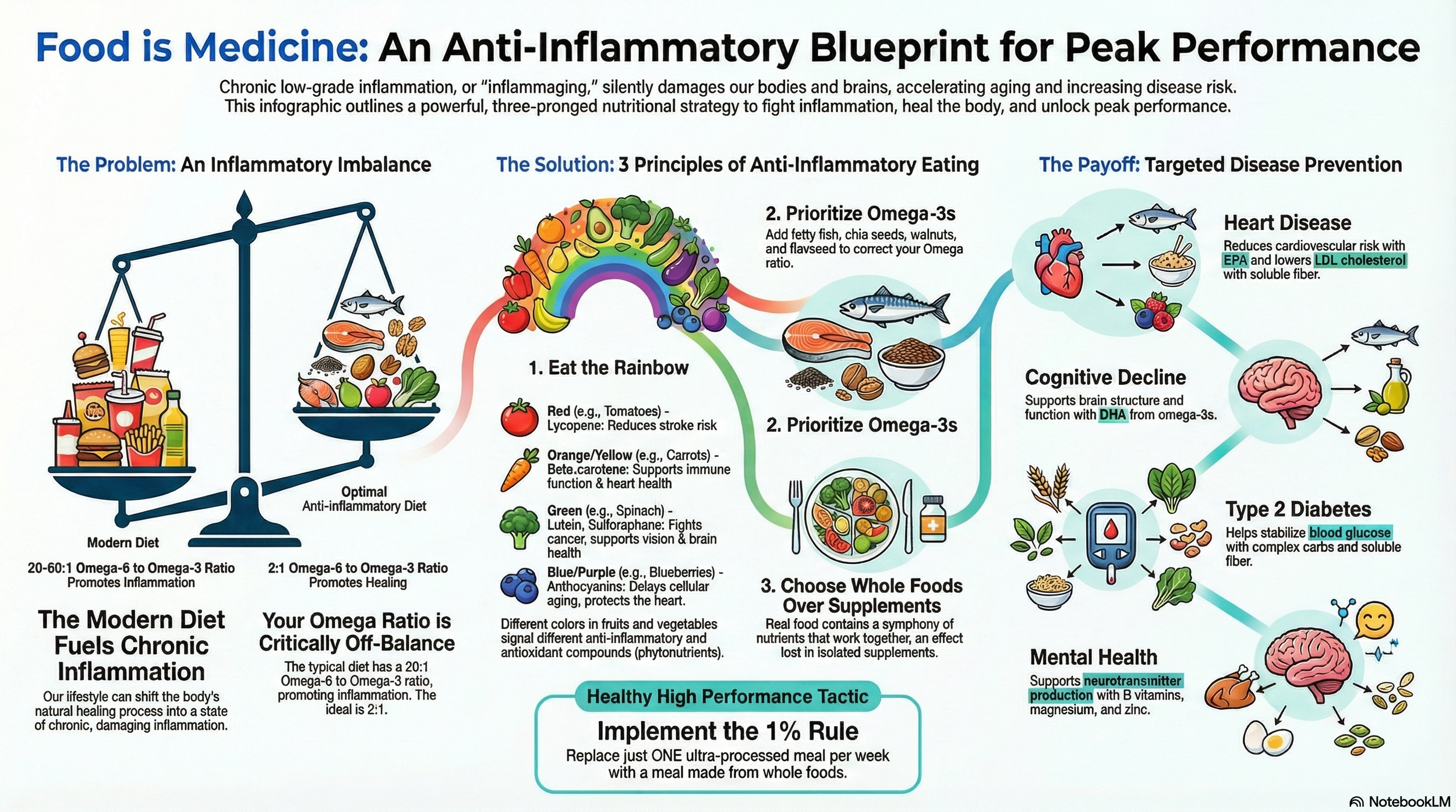
The first principle is to address the omega-6 to omega-3 ratio. Your body thrives when you consume roughly 2 parts omega-6 to one part omega-3. Yet the typical North American diet is wildly out of balance, with omega 6 levels 20-60 times higher than omega-3 levels. This imbalance shifts both your body and brain towards a more inflammatory state [1], [2]. A simple first step is to add more omega-3 rich foods into your diet, such as fatty fish (salmon, tuna, mackerel) which provide both EPA and DHA, and omega-3 rich plant sources such as chia seeds, walnuts, flaxseed oil and hemp seeds, which provide ALA.
2. Eat The Rainbow: Colorful Vegetables and Their Health Benefits
But rebalancing this ratio is just the start. The second key principle is to eat the rainbow by consuming a variety of colorful fruits and vegetables which contain potent antioxidants that help fight inflammation. Different colors indicate different phytonutrients, with each color telling a nutritional story:
· Red fruits and vegetables like tomatoes and strawberries are rich in lycopene, a potent antioxidant linked to reduced risk of stroke [3].
· Orange and yellow produce like carrots and sweet potatoes contain beta-carotene, which supports immune function and vision. Carrot consumption, in particular, was found to potently reduce the risk of cardiovascular disease [4].
· Green vegetables, especially dark leafy greens like spinach, contain lutein important for fighting cancer and supporting vision and brain health [5], [6], [7], while cruciferous vegetables like broccoli contain sulforaphane and indoles, compounds with powerful cancer-fighting properties [8], [9].
· Blue and purple fruits like blueberries and haskaps contain anthocyanins, which delay cellular aging, fight cancer, and protect the heart [10], [11].
The American Cancer Society recommends eating at least 2.5 to 3 cups of vegetables and 1.5 to 2 cups of fruit each day, and mixing these colors ensures you're getting the full spectrum of protective compounds.
3. Whole Unprocessed Foods Beat Supplements
The third key principle is that whole foods are always superior to supplements, and real foods (that are around the perimeter of most grocery stores) are superior to ultraprocessed, prepackaged calories. A carrot contains not just beta-carotene but also fiber, potassium, and hundreds of other micronutrients and phytonutrients that work synergistically. When you extract a single nutrient into a supplement, you lose this symphony of compounds.
Health Optimization Through Nutrition
Stepping beyond its role in lowering inflammation, what we eat actively shapes how every system in your body performs. From the heart and brain to the immune system and gut, specific nutrients can protect against diseases, optimizing both physical and mental health at the cellular level:
Heart disease: EPA from omega-3 foods (Fatty fish, fish oils) can help reduce cardiovascular risk [12], while mono and polyunsaturated fats (MUFA/PUFA) from plant oils and avocados support healthy cholesterol levels. Soluble fiber (oats, beans, lentils, psyllium, apples) can lower LDL cholesterol [13], and antioxidants from orange/red vegetables, berries, and dark leafy greens contribute to overall heart health [4]. Consider the Mediterranean Diet or the DASH Diet.
Cancer: Phytonutrients and antioxidants from colorful fruit and vegetables, legumes, and cruciferous vegetables like broccoli and kale may help reduce cancer risk. Swapping out red and processed meats for more plant-based proteins can further support cancer prevention efforts [14], [15].
Type 2 Diabetes: Complex carbohydrates containing soluble fiber (whole grain breads and cereals), resistant starch (whole grains, legumes, cooked and cooled potatoes, rice), help stabilize blood glucose. Healthy fats from nuts and avocados, leafy green vegetables further support metabolic control [16]. Consider the Green Mediterranean Diet.
Alzheimer's and cognitive decline: DHA from omega-3 foods (fatty fish, fish oils), plant-based proteins, olive oil, nuts and berries, support brain structure and cognitive function [17]. Consider the MIND diet.
Mental health: B vitamins (folate, B12, B6) found in poultry, fish, eggs, leafy green vegetables, legumes, and magnesium and zinc found in nuts, seeds, and legumes, play key roles in neurotransmitter production and mood regulation. Your gut bacteria communicate directly with your brain through the gut-brain axis, making digestive health inseparable from mental wellbeing, so include both probiotics (sauerkraut, kefir, kombucha, kimchi) and prebiotics (garlic, onions, sunchokes). Consider the MIND diet or Mediterranean Diet with added probiotic/prebiotic foods [18], [19].
The pattern is clear: whole foods in their natural form are the most powerful tool for lowering disease risk and extending your healthspan.
The Path Forward
Food is indeed medicine—every bite either fights inflammation and disease or feeds it. Now that you understand why nutrition matters, the next article will show you exactly how to eat smarter for focus, energy, and peak performance.
1% TIP: REPLACE ONE ULTRAPROCESSED MEAL PER WEEK WITH WHOLE FOODS.
Add one serving of colorful vegetables to each meal. Choose whole grains instead of refined carbohydrates. Grab a handful of mixed nuts instead of chips for a snack. Small dietary improvements compound over time, and these small, sustainable changes are far more powerful than any restrictive diet or expensive supplement.
References
[1] L. Cordain et al., “Origins and evolution of the Western diet: health implications for the 21st century.,” Am. J. Clin. Nutr., vol. 81, no. 2, pp. 341–354, Feb. 2005, doi: 10.1093/ajcn.81.2.341.
[2] C. Sanchez et al., “Dietary fatty acid composition drives neuroinflammation and impaired behavior in obesity,” Brain. Behav. Immun., vol. 117, pp. 330–346, 2024, doi: https://doi.org/10.1016/j.bbi.2024.01.216.
[3] A. Bahonar, M. Saadatnia, F. Khorvash, M. Maracy, and A. Khosravi, “Carotenoids as Potential Antioxidant Agents in Stroke Prevention: A Systematic Review.,” Int. J. Prev. Med., vol. 8, p. 70, 2017, doi: 10.4103/ijpvm.IJPVM_112_17.
[4] L. M. Oude Griep, W. M. M. Verschuren, D. Kromhout, M. C. Ocké, and J. M. Geleijnse, “Colours of fruit and vegetables and 10-year incidence of CHD.,” Br. J. Nutr., vol. 106, no. 10, pp. 1562–1569, Nov. 2011, doi: 10.1017/S0007114511001942.
[5] M.-C. García-Romera, M.-C. Silva-Viguera, I. López-Izquierdo, A. López-Muñoz, R. Capote-Puente, and B. Gargallo-Martínez, “Effect of macular pigment carotenoids on cognitive functions: A systematic review.,” Physiol. Behav., vol. 254, p. 113891, Oct. 2022, doi: 10.1016/j.physbeh.2022.113891.
[6] M. S. Donaldson, “Nutrition and cancer: a review of the evidence for an anti-cancer diet.,” Nutr. J., vol. 3, p. 19, Oct. 2004, doi: 10.1186/1475-2891-3-19.
[7] A. A. Firozjae, M. R. Shiran, and M. Rashidi, “The neuropharmacological and clinical effects of lutein: a systematic review.,” Horm. Mol. Biol. Clin. Investig., vol. 46, no. 1, pp. 27–38, Mar. 2025, doi: 10.1515/hmbci-2024-0053.
[8] P. Mirmiran, Z. Bahadoran, F. Hosseinpanah, A. Keyzad, and F. Azizi, “Effects of broccoli sprout with high sulforaphane concentration on inflammatory markers in type 2 diabetic patients: A randomized double-blind placebo-controlled clinical trial,” J. Funct. Foods, vol. 4, no. 4, pp. 837–841, 2012, doi: https://doi.org/10.1016/j.jff.2012.05.012.
[9] D. Ağagündüz, T. Ö. Şahin, B. Yılmaz, K. D. Ekenci, Ş. Duyar Özer, and R. Capasso, “Cruciferous Vegetables and Their Bioactive Metabolites: from Prevention to Novel Therapies of Colorectal Cancer.,” Evid. Based. Complement. Alternat. Med., vol. 2022, p. 1534083, 2022, doi: 10.1155/2022/1534083.
[10] W. Kalt et al., “Recent Research on the Health Benefits of Blueberries and Their Anthocyanins.,” Adv. Nutr., vol. 11, no. 2, pp. 224–236, Mar. 2020, doi: 10.1093/advances/nmz065.
[11] M. Gołba, A. Sokół-Łętowska, and A. Z. Kucharska, “Health Properties and Composition of Honeysuckle Berry Lonicera caerulea L. An Update on Recent Studies.,” Molecules, vol. 25, no. 3, Feb. 2020, doi: 10.3390/molecules25030749.
[12] A. Giosuè, I. Calabrese, R. Lupoli, G. Riccardi, O. Vaccaro, and M. Vitale, “Relations between the Consumption of Fatty or Lean Fish and Risk of Cardiovascular Disease and All-Cause Mortality: A Systematic Review and Meta-Analysis,” Adv. Nutr., vol. 13, no. 5, pp. 1554–1565, 2022, doi: https://doi.org/10.1093/advances/nmac006.
[13] M. Pandey et al., “Effectiveness of High-Fiber, Plant-Based Diets in Reducing Cardiovascular Risk Factors Among Middle-Aged and Older Adults: A Systematic Review.,” Cureus, vol. 16, no. 8, p. e67660, Aug. 2024, doi: 10.7759/cureus.67660.
[14] N. Kamal et al., “Genesis and Mechanism of Some Cancer Types and an Overview on the Role of Diet and Nutrition in Cancer Prevention.,” Molecules, vol. 27, no. 6, Mar. 2022, doi: 10.3390/molecules27061794.
[15] S. Parra-Soto et al., “Association of meat, vegetarian, pescatarian and fish-poultry diets with risk of 19 cancer sites and all cancer: findings from the UK Biobank prospective cohort study and meta-analysis.,” BMC Med., vol. 20, no. 1, p. 79, Feb. 2022, doi: 10.1186/s12916-022-02257-9.
[16] U. Qureshi, A. Bajwa, Z. Aslam, A. Aggrey, U. H. Nawaz, and Q. Ul Ain, “Gut Microbiota Modulation in Type 2 Diabetes and Cardiometabolic Risk: A Systematic Review.,” Cureus, vol. 17, no. 9, p. e92020, Sep. 2025, doi: 10.7759/cureus.92020.
[17] A. P. van Soest, S. Beers, O. van de Rest, and L. C. de Groot, “The Mediterranean-Dietary Approaches to Stop Hypertension Intervention for Neurodegenerative Delay (MIND) Diet for the Aging Brain: A Systematic Review.,” Adv. Nutr., vol. 15, no. 3, p. 100184, Mar. 2024, doi: 10.1016/j.advnut.2024.100184.
[18] R. Hussen Kabthymer et al., “Effect of Mediterranean diet on mental health outcomes: A systematic review.,” Nutr. Res. Rev., pp. 1–65, Nov. 2025, doi: 10.1017/S0954422425100243.
[19] K. Torabynasab, H. Shahinfar, S. Jazayeri, M. Effatpanah, L. Azadbakht, and J. Abolghasemi, “Adherence to the MIND diet is inversely associated with odds and severity of anxiety disorders: a case-control study.,” BMC Psychiatry, vol. 23, no. 1, p. 330, May 2023, doi: 10.1186/s12888-023-04776-y.