Sleep is Your Ultimate Performance-Enhancing Drug (No Prescription Required)
Years ago, my daughter got incredibly sick with a bad flu virus that made its way into her brain, leaving her fighting for her life in the pediatric ICU at SickKids Hospital. Those days were the most frightening and uncertain of my life, and my wife and I searched desperately for answers as the incredible team at SickKids worked around the clock to help her recover. Wanting to do everything possible to support her healing, we pored over the science together, and again and again, sleep came up as a vital factor in brain recovery. That experience became a catalyst for my deep dive into the world of sleep and its powerful impacts on our physiology, mood, and cognition. What I learned, both as a scientist and a parent, is that sleep benefits go far beyond rest—sleep is the foundation of health and thriving.

The Sleep Crisis
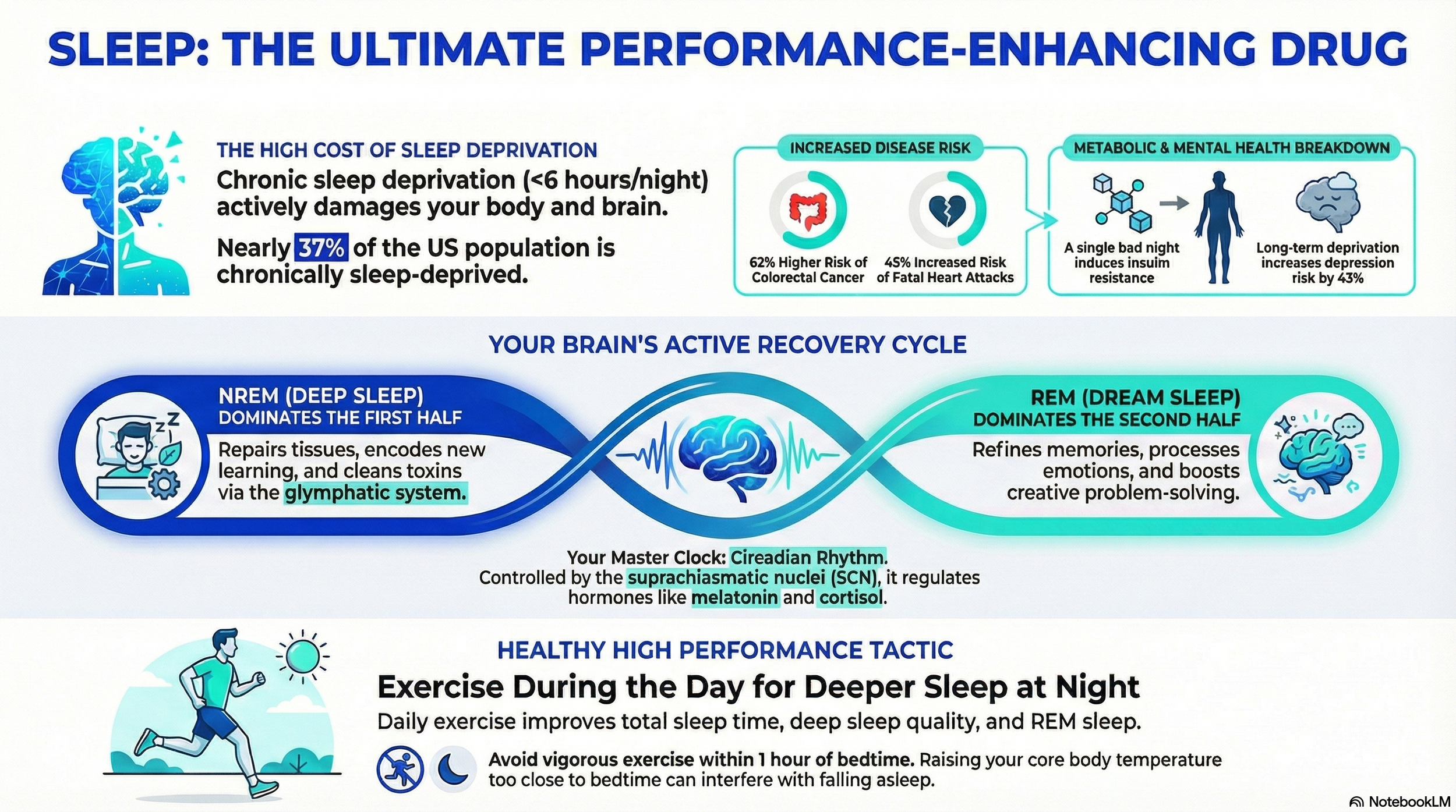
We're living through a global sleep deprivation epidemic. According to the CDC, almost 37% of the US population is chronically sleep-deprived, and we're sleeping 20% less than people did a century ago. We've convinced ourselves that sleep is optional, that it is something we can sacrifice to get more done, answer more emails, binge another series, or scroll through social media one more time. But here's the truth: sleep deprivation is shortening our lives, damaging our relationships, crushing our performance, and stealing our potential.
Your Body's Internal Clock
Inside your brain sits a pair of structures called the suprachiasmatic nuclei (SCN), your body's master clock, and control center for your body’s circadian rhythms. These tiny pacemakers regulate everything: when you wake up, when you feel hungry, when your body temperature rises and falls, and when hormones like melatonin (which makes you drowsy), leptin and ghrelin (which regulate appetite), and cortisol (which wakes you up) are released into your bloodstream. A healthy circadian rhythm is essential for optimizing sleep quality and daily energy.
For most of human history, we lived in sync with the sun: waking when it rose, sleeping when it set. Today, we work indoors for 8+ hours, often under LED lights that lack the full spectrum of natural sunlight, and then spend our evenings bathed in the blue glow of screens. Our internal clocks are completely out of sync, and both our physical and mental health are paying the price.
What Your Brain is Doing During Sleep
Sleep isn't passive—it's active recovery. Your brain and body are working incredibly hard while you rest. While there are multiple sleep stages, they can be broadly classified into two types: REM (Rapid Eye Movement) and NREM (Non-Rapid Eye Movement). NREM includes the deep, slow-wave sleep that dominates the first half of the night and regulates important cellular processes in your brain and body:
· Releases anabolic hormones that repair tissues and stabilize energy levels.
· Supports maturation and integration of new neurons [1].
· Encodes new information and learning into memory [2].
· Clears metabolic waste from your brain via the glymphatic system—a microscopic network that literally "washes" your brain of toxins, including the amyloid-beta protein that accumulates in Alzheimer's disease [3].
During the second half of the night, REM sleep dominates. This sleep is not just our key “dream” state, it is also important for:
· Growing new neurons in your brain and strengthening connections between existing neurons [4].
· Refining and organizing memory consolidation (removing noise and chaos, and strengthening important information)[5].
· Engaging in subconscious creative problem-solving [6].
· Processing emotions and experiences from the day [7].
Both types of sleep are essential and work in harmony, with their nightly alternation playing a key role in creative thinking and the ability to see different solutions. If you lose out on either stage, your brain can’t properly encode and retain information, and your body is unable to fully recover.
The Dangers of Sleep Deprivation: Why Sleep Hygiene and Consistent Sleep Routines Matter
New research into sex differences has determined that the optimal sleep duration for men is 7.0-8.0 hours, and for women it is 7.5-8.5 hours [8]. When you sleep fewer than 6 hours per night, you're not just tired, you're actively damaging your body:
· 62% higher risk of colorectal cancer [8].
· 45% increased risk of fatal heart attacks (for women) [9].
· Disrupts lipid storage systems and promotes insulin resistance [9].
· Increased inflammatory markers and suppressed immune function, making you more vulnerable to infections and disease [10].
· Impacts to mental health: 43% increased risk of developing depression, 30% increased risk of developing anxiety [11].
Even one night of poor sleep makes your fat cells act like they have type 2 diabetes, becoming insulin-resistant and unable to properly store energy [12].
Sleep: The Ultimate Performance Enhancer
If someone invented a drug that improved memory, creativity, athletic performance, immune function, emotional regulation, and longevity—all with zero side effects—it would be hailed as a miracle. That drug exists. It's called sleep. You don't need a prescription. You don't need expensive equipment. You just need to understand the importance of sleep and prioritize it. You need a strategic sleep routine. In my next article, I'll reveal the specific sleep hygiene techniques, including environmental optimization, light management, timing protocols, and pre-sleep rituals, that transform sleep from uncertain to inevitable. These aren't abstract concepts; they're concrete practices that, when combined into a consistent sleep routine, become the most powerful recovery tool you'll ever implement.
1% TIP: EXERCISE FOR BETTER SLEEP BENEFITS
Exercise has beneficial effects on total sleep time, how long it takes to fall asleep, the quality of sleep, how much time we spend in deep sleep, and the quality of REM sleep [13]. You can exercise in the morning or evening, whichever works best for you, but you should avoid vigorous exercise that raises your body temperature within 1 hour of bedtime. I have found that when I work out during the day, my time in deep sleep increases, and the total amount of sleep that I need to feel recovered actually goes down (I wake up easily after about 7 hours of sleep instead of 8). Put simply, if you want to sleep better, get some exercise during the day.
References
[1] P. Meerlo, R. E. Mistlberger, B. L. Jacobs, H. C. Heller, and D. McGinty, “New neurons in the adult brain: the role of sleep and consequences of sleep loss.,” Sleep Med. Rev., vol. 13, no. 3, pp. 187–194, Jun. 2009, doi: 10.1016/j.smrv.2008.07.004.
[2] L. Keeble, P. Monaghan, E. M. Robertson, and S. Hannan, “Slow-wave sleep as a key player in offline memory processing: insights from human EEG studies.,” Front. Behav. Neurosci., vol. 19, p. 1620544, 2025, doi: 10.3389/fnbeh.2025.1620544.
[3] O. C. Reddy and Y. D. van der Werf, “The Sleeping Brain: Harnessing the Power of the Glymphatic System through Lifestyle Choices.,” Brain Sci., vol. 10, no. 11, Nov. 2020, doi: 10.3390/brainsci10110868.
[4] W. Li, L. Ma, G. Yang, and W.-B. Gan, “REM sleep selectively prunes and maintains new synapses in development and learning.,” Nat. Neurosci., vol. 20, no. 3, pp. 427–437, Mar. 2017, doi: 10.1038/nn.4479.
[5] A. E. Shuster et al., “REM refines and rescues memory representations: a new theory.,” Sleep Adv. a J. Sleep Res. Soc., vol. 6, no. 1, p. zpaf004, 2025, doi: 10.1093/sleepadvances/zpaf004.
[6] P. A. Lewis, G. Knoblich, and G. Poe, “How Memory Replay in Sleep Boosts Creative Problem-Solving.,” Trends Cogn. Sci., vol. 22, no. 6, pp. 491–503, Jun. 2018, doi: 10.1016/j.tics.2018.03.009.
[7] C. Yuksel et al., “Both slow wave and rapid eye movement sleep contribute to emotional memory consolidation,” Commun. Biol., vol. 8, no. 1, p. 485, 2025, doi: 10.1038/s42003-025-07868-5.
[8] M. Rossi et al., “Gender correlation between sleep duration andrisk of coronar heart disease: a systematic review and meta-analysis,” Eur. J. Cancer Prev., Nov. 2025, doi: 10.1097/CEJ.0000000000000993.
[9] C. Li, S. Luo, T. Liang, D. Song, and J. Fu, “Gender correlation between sleep duration and risk of coronary heart disease: a systematic review and meta-analysis,” Front. Cardiovasc. Med., vol. Volume 12-2025, 2025, [Online]. Available: https://www.frontiersin.org/journals/cardiovascular-medicine/articles/10.3389/fcvm.2025.1452006
[10] B. Faraut, K. Z. Boudjeltia, L. Vanhamme, and M. Kerkhofs, “Immune, inflammatory and cardiovascular consequences of sleep restriction and recovery,” Sleep Med. Rev., vol. 16, no. 2, pp. 137–149, 2012, doi: https://doi.org/10.1016/j.smrv.2011.05.001.
[11] J. Zhang, M. He, X. Wang, H. Jiang, J. Huang, and S. Liang, “Association of sleep duration and risk of mental disorder: a systematic review and meta-analysis.,” Sleep Breath., vol. 28, no. 1, pp. 261–280, Mar. 2024, doi: 10.1007/s11325-023-02905-1.
[12] E. Donga et al., “A Single Night of Partial Sleep Deprivation Induces Insulin Resistance in Multiple Metabolic Pathways in Healthy Subjects,” J. Clin. Endocrinol. Metab., vol. 95, no. 6, pp. 2963–2968, Jun. 2010, doi: 10.1210/jc.2009-2430.
[13] M. A. Kredlow, M. C. Capozzoli, B. A. Hearon, A. W. Calkins, and M. W. Otto, “The effects of physical activity on sleep: a meta-analytic review.,” J. Behav. Med., vol. 38, no. 3, pp. 427–449, Jun. 2015, doi: 10.1007/s10865-015-9617-6.