Rest Is Your Secret Weapon: Why Recovery Is the Foundation of Peak Energy
Two people start their day at the same time. One powers through without breaks, skips lunch at the desk, fights the afternoon fog with another coffee, and collapses on the couch when the family needs them most. The other takes strategic pauses, eats a protein-packed lunch, moves for five minutes between meetings, and arrives home with energy to spare. Same hours. Radically different outcomes. The difference isn't willpower or discipline. It's understanding that rest isn't the opposite of work—it's what makes work possible through strategic recovery techniques that restore energy and prevent burnout.

The Energy Crisis: Why We're Always Tired and Exhausted
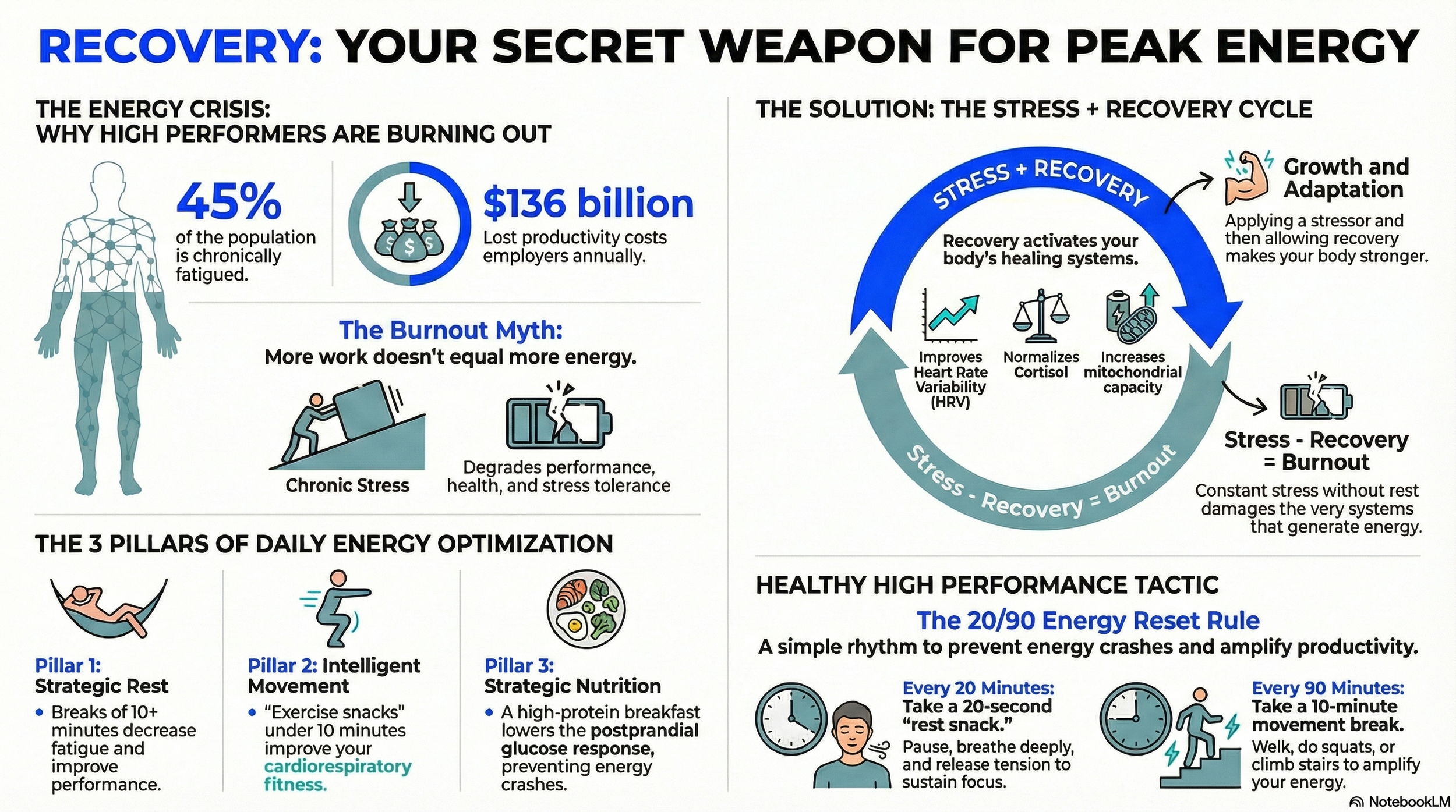
We're tired in ways we've never been before. Approximately 45% of the North American population is chronically fatigued, and this fatigue is associated with increased risk of developing mental and physical diseases. Researchers found that 65% of people with fatigue reported health-related lost productivity, costing employers an estimated $136 billion annually [1].
Here's what makes it worse: we blame ourselves. We think we're not pushing hard enough. But the real problem is that we never rest. And when we do take a break, guilt floods in. We end up neither working effectively nor recovering properly, finding ourselves trapped in a cycle that drains us further.
The Burnout Myth: Why More Work Doesn't Equal More Energy
Our culture tells us that working non-stop leads to success. The reality is precisely the opposite. Chronic stress without recovery equals burnout, decreased productivity, and worse performance.
When stressors exceed our ability to cope, our sleep is disturbed, and our immune system is compromised. We become more likely to get sick and take longer to recover. Anxiety and depression spike along with blood pressure. The physiological stress response persists, and eventually the body enters an exhaustion stage marked by burnout, fatigue, depression, anxiety, and reduced stress tolerance.
Elite athletes understand this intuitively. They use "load management" and tapering—deliberately reducing training before competition, because they know that fatigue decreases faster than fitness. The same principle applies to knowledge work and daily life: strategic recovery amplifies performance.
Understanding the Stress-Recovery Cycle for Lasting Energy
Your body operates on a simple but powerful cycle: stress followed by recovery leads to adaptation and growth. Acute stress, when followed by rest and recharging, makes you stronger. But stress without recovery creates a vicious spiral that reduces mitochondrial function, leading to even greater loss of energy and increased burnout [2].
When you allow recovery, your parasympathetic nervous system activates, triggering healing and regeneration. Heart rate variability improves. Cortisol normalizes. Your body repairs at the cellular level including building mitochondrial capacity. When you don't, you remain locked in sympathetic overdrive, and chronic stress damages the very systems designed to help you recover.
The Three Pillars of Daily Energy Optimization: Rest, Movement, and Nutrition
Energy isn't mysterious. It comes from three foundational practices:
Strategic Rest includes both quality sleep and micro-breaks throughout the day. A systematic review of 83 studies found that breaks of 10 minutes or more decrease stress and fatigue while improving performance [3]. Longer breaks produce better performance outcomes, particularly for creative and routine tasks. Even micro-breaks (brief pauses taken at your discretion) can efficiently alleviate the negative effects of work demands, reducing fatigue and negative affect while increasing engagement [4].
Movement generates energy rather than depleting it. Research shows that "exercise snacks" comprised of short bouts of activity under 10 minutes can improve cardiorespiratory fitness [5], [6]. Dr. Jonathan Little from the University of British Columbia discovered that exercising for as little as 20 seconds a few times throughout the day is enough to improve cardiorespiratory fitness and overall health [7]. A few flights of stairs, 10 squats by your desk, a five-minute walk—these quick bursts improve both focus and health. As I have covered in earlier articles, longer stretches of activity and exercise amplify these effects.
Nutrition fuels your energy systems strategically. Research shows that a high-protein breakfast produces a 16% lower postprandial glucose response compared to a carbohydrate-heavy breakfast, with effects that carry through to lunch and dinner [8] . This sustained blood sugar stability prevents the energy crashes that come from refined sugars and processed foods.
Optimizing Your Energy Curve with Circadian Rhythms
Your energy follows natural circadian rhythms. Cortisol rises in the morning, creating peak alertness and focus. It then gradually declines, with most people experiencing a noticeable dip in the early-to-mid afternoon—the infamous "2 p.m. slump."
Understanding this curve allows you to work with your biology rather than against it. Schedule demanding cognitive work during morning peaks. Use the afternoon dip for routine tasks or, better yet, a brief rest or movement break. A 5-10-minute power nap in the early afternoon aligns with your circadian rhythm and ensures you wake refreshed rather than groggy.
Building Energy Reserves: From Strategic Rest to Peak Performance
Now that you understand the science of the stress-recovery cycle, and why rest is an essential component of the three pillars of energy optimization, the next article will show you how to build your energy optimization toolkit, starting with small daily practices that will take you from drained to dominant.
1% TIP: THE 20/90 RULE FOR ENERGY RESET: REST SNACKS + MOVEMENT BREAKS
Two simple rules compound into sustained energy throughout your workday: for every 20 minutes of focused work, take a 20-second "rest snack": pause, breathe deeply, release muscle tension. Every 90 minutes, invest 10 minutes in movement: a walk, squats, climbing stairs, anything that gets you moving. This rhythm prevents energy crashes that derail productivity and mood. Rest snacks sustain energy; movement breaks amplify it.
References
[1] J. A. Ricci, E. Chee, A. L. Lorandeau, and J. Berger, “Fatigue in the U.S. workforce: prevalence and implications for lost productive work time.,” J. Occup. Environ. Med., vol. 49, no. 1, pp. 1–10, Jan. 2007, doi: 10.1097/01.jom.0000249782.60321.2a.
[2] S. Brand et al., “Influence of Regular Physical Activity on Mitochondrial Activity and Symptoms of Burnout-An Interventional Pilot Study.,” J. Clin. Med., vol. 9, no. 3, Mar. 2020, doi: 10.3390/jcm9030667.
[3] Z. Lyubykh et al., “Role of work breaks in well-being and performance: A systematic review and future research agenda.,” J. Occup. Health Psychol., vol. 27, no. 5, pp. 470–487, Oct. 2022, doi: 10.1037/ocp0000337.
[4] P. Albulescu, I. Macsinga, A. Rusu, C. Sulea, A. Bodnaru, and B. T. Tulbure, “‘Give me a break!’ A systematic review and meta-analysis on the efficacy of micro-breaks for increasing well-being and performance.,” PLoS One, vol. 17, no. 8, p. e0272460, 2022, doi: 10.1371/journal.pone.0272460.
[5] N. I. Brown, J. Henderson, M. Stern, and T. L. Carson, “Health-Related Benefits and Adherence for Multiple Short Bouts of Aerobic Physical Activity Among Adults.,” Am. J. Lifestyle Med., vol. 19, no. 1, pp. 58–72, Jan. 2025, doi: 10.1177/15598276241253160.
[6] M. Á. Rodríguez, M. Quintana-Cepedal, B. Cheval, C. Thøgersen-Ntoumani, I. Crespo, and H. Olmedillas, “Effect of exercise snacks on fitness and cardiometabolic health in physically inactive individuals: systematic review and meta-analysis,” Br. J. Sports Med., p. bjsports-2025-110027, Oct. 2025, doi: 10.1136/bjsports-2025-110027.
[7] H. Islam, M. J. Gibala, and J. P. Little, “Exercise Snacks: A Novel Strategy to Improve Cardiometabolic Health.,” Exerc. Sport Sci. Rev., vol. 50, no. 1, pp. 31–37, Jan. 2022, doi: 10.1249/JES.0000000000000275.
[8] Y.-M. Park et al., “A high-protein breakfast induces greater insulin and glucose-dependent insulinotropic peptide responses to a subsequent lunch meal in individuals with type 2 diabetes.,” J. Nutr., vol. 145, no. 3, pp. 452–458, Mar. 2015, doi: 10.3945/jn.114.202549.