Sleep Smarter: The Science-Backed Blueprint for Better Rest
In the last article, I explained why sleep and performance are inseparable. Sleep isn't just important, it's non-negotiable. Now let's move from understanding why sleep matters to building the sleep routine that actually works. If you want to transform your sleep, the answer is not in gimmicks or fancy tech. The secret is building healthy routines (aka “sleep hygiene”) that include timing your sleep, modifying your environment and understanding what your body really needs, all grounded in science.

Sleep Consistency Matters: Why a Regular Sleep Schedule Beats Sleep Duration Alone
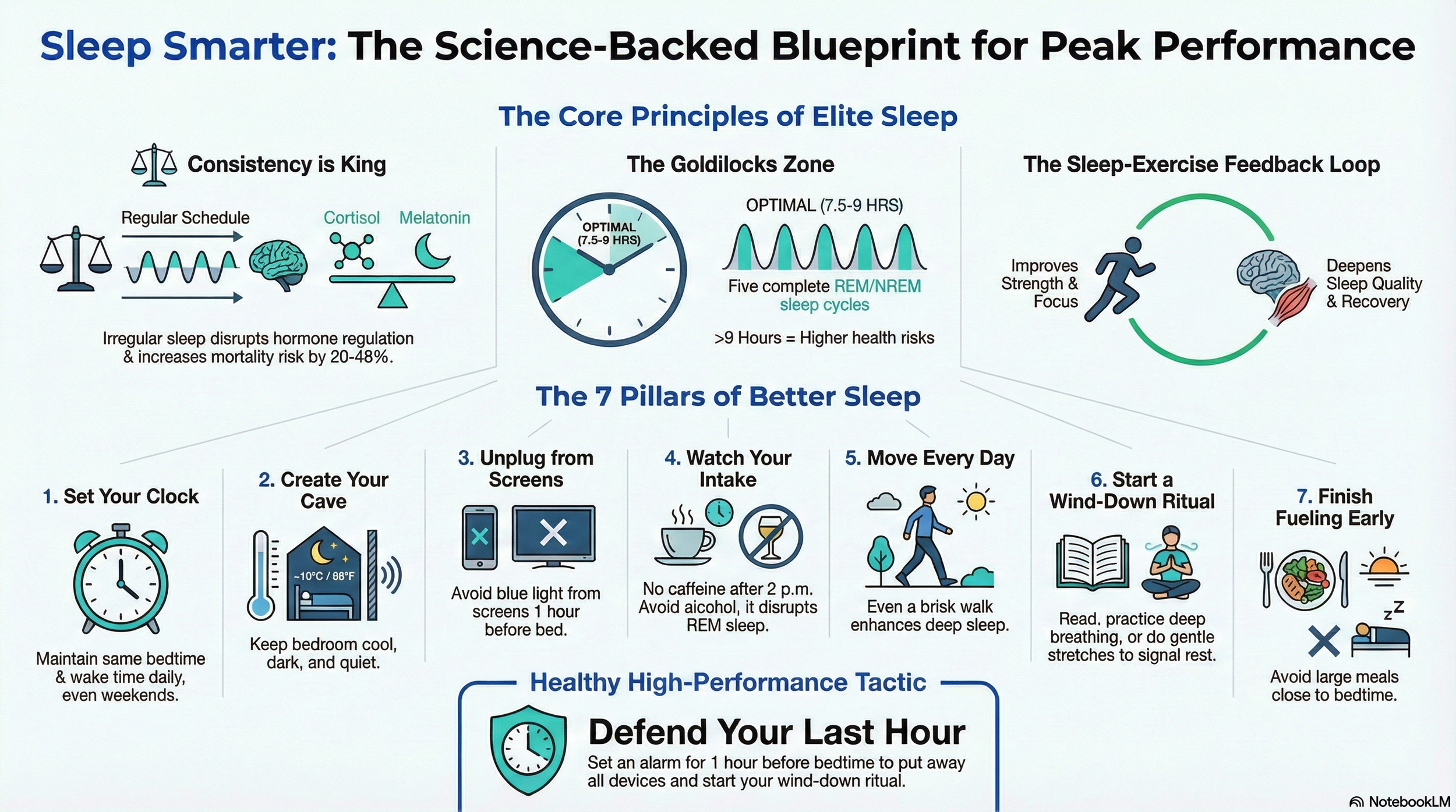
Getting up and going to bed at the same time every day is as important as getting enough hours of sleep. Research shows that when our sleep schedule goes off track (what scientists call “social jet lag”), our natural hormone rhythms are disrupted. This can interfere with the release of melatonin and cortisol, scramble memory consolidation, and leave you feeling groggy and unfocused, even if you technically spend enough time in bed. Consistent sleep times teach your brain when to wind down. Over time, this makes it much easier to fall asleep and get quality rest every night.
Consistent sleep is also linked to longevity and health span: a landmark 2024 retrospective study looked at data from over 60,000 participants in the UK Biobank and found those whose sleep-wake times varied significantly from day to day had a 20-48% higher risk of all-cause mortality compared to those with consistent sleep schedules, even after accounting for sleep duration [1]. Sleep regularity may be a stronger predictor of mortality than the total hours slept, making it a critical yet underappreciated component of sleep health.
The Goldilocks Zone: How Much Sleep Is Enough?
In my last article, I highlighted that optimal sleep duration differs slightly for men and women, but in general, 7.5 hours is a great target for both, since it allows for five complete REM/NREM sleep cycles. But here’s the kicker – too much sleep is just as bad, or worse than too little: sleeping for more than 9 hours per night is associated with even higher risks of dying from cancer, cardiovascular, and other diseases [2].
The science is decisive: sleep consistency and optimal sleep duration work together. Maintaining regular sleep-wake times while getting 7-8.5 hours of quality sleep is foundational to sleep quality, longevity, and mental health, and more powerful than any other single intervention.
The Sleep-Exercise Partnership
Many people do not realize this, but research shows that sleep and exercise support each other in a powerful feedback loop. Good sleep makes you stronger, helps you recover, and improves focus for every workout. On the flip side, being active every day deepens your sleep and makes it easier to drift off. Even one session of exercise, whether it is a workout or just a brisk walk, can help you spend more time in deep sleep that same night. Think of it this way: the more you move, the better you sleep. The better your sleep, the easier it is to move.
The Seven Pillars of Better Sleep
These seven sleep habits and sleep hygiene techniques are simple, but they work when done consistently. Implement these best sleep tips to build your personalized sleep routine:
Be consistent with bed and wake times every day, including weekends.
Keep your bedroom cool, dark, and quiet. Start lowering light levels an hour before bed, and make sure all lights are blocked when you go to sleep. Set the temperature to about 19°C for the best rest.
Avoid screens for at least one hour before you plan to sleep. Light from phones and TVs blocks melatonin production and makes it harder to fall asleep.
Limit caffeine. No coffee, tea, or energy drinks after 2 p.m. Avoid alcohol – it interferes with REM sleep cycles.
Move. Every. Day. Even a walk makes a difference.
Use a relaxing nighttime ritual. Try reading, deep breathing, or gentle stretching.
Stay hydrated and finish your meals early. Avoid big meals close to bedtime.
These are not revolutionary ideas but putting them into practice makes all the difference. Small steps, done consistently, will help you unlock the powerful benefits of sleep.
Once your sleep timing and habits are in place, you are set up for success. If you still find yourself struggling with sleep problems or insomnia, don’t worry. In the next article, I will break down proven, real-world solutions for getting past those sleepless nights.
1% TIP: DEFEND YOUR LAST HOUR BEFORE SLEEP
Commit to spending the last hour before bedtime in a calm way, without the added blue light and mental distraction of screens and doom scrolling. Set your alarm for one hour before your evening bedtime, and then follow through with putting away devices, lowering the lights, and incorporating your wind-down ritual. Making this a nightly habit will help you transition toward deeper, more restorative sleep.
References
[1] D. P. Windred et al., “Sleep regularity is a stronger predictor of mortality risk than sleep duration: A prospective cohort study,” Sleep, vol. 47, no. 1, p. zsad253, Jan. 2024, doi: 10.1093/sleep/zsad253.
[2] F. P. Cappuccio, L. D’Elia, P. Strazzullo, and M. A. Miller, “Sleep duration and all-cause mortality: a systematic review and meta-analysis of prospective studies.,” Sleep, vol. 33, no. 5, pp. 585–592, May 2010, doi: 10.1093/sleep/33.5.585.