The Cold Truth: How Cold Water Builds Your Stress Resilience
In the previous article, we explored how breathing activates the vagus nerve and shifts your nervous system from fight-or-flight to rest-and-recover mode. Now, let's explore another powerful tool for emotional regulation: cold exposure. It sounds counterintuitive, but cold water actually trains your body to handle stress better. The discomfort is the point.
Cold Water Therapy: The Science
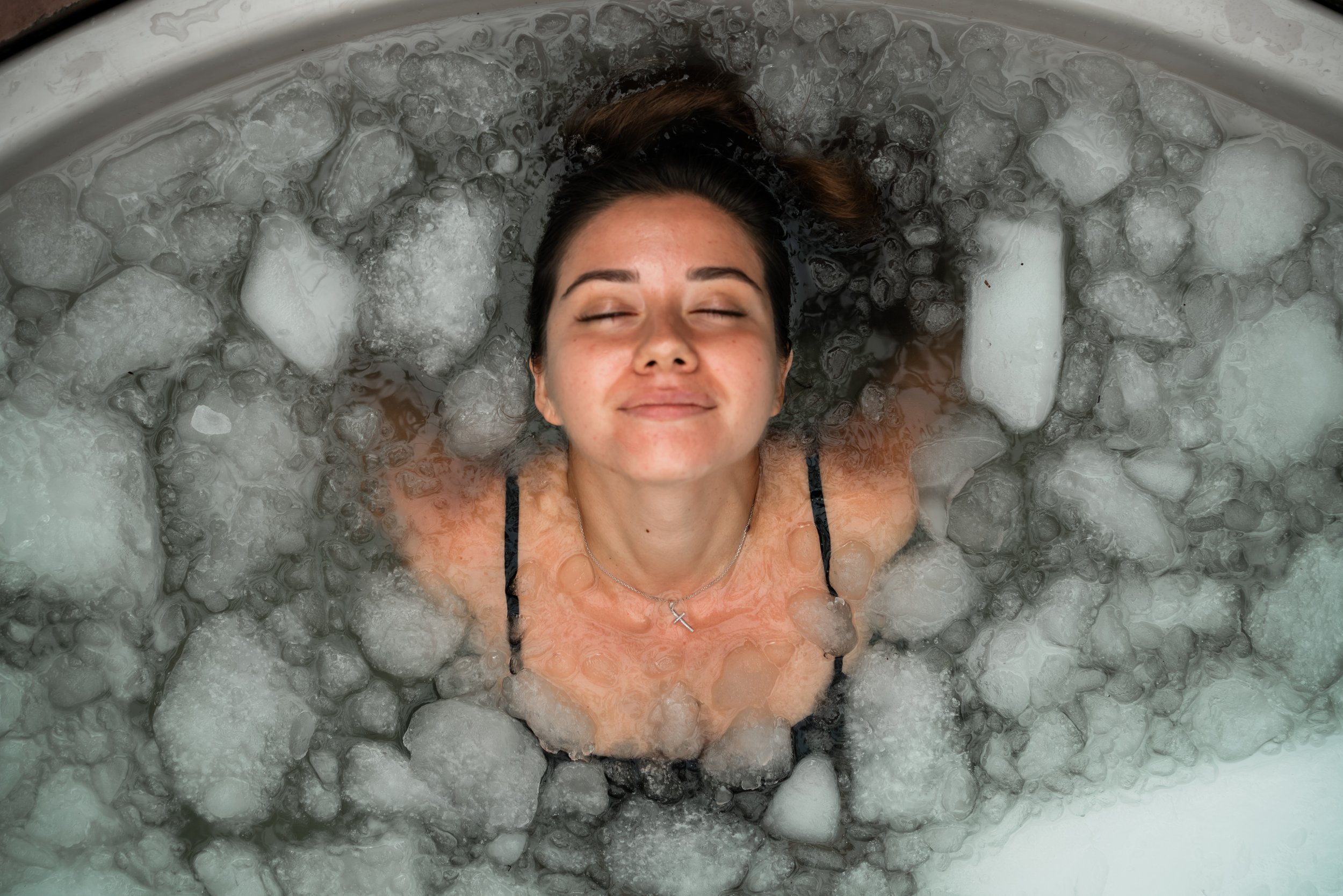
A survey of participants who combine cold exposure with meditation/control and breathwork exercises, found that participants commonly reported positive changes in their energy levels, awareness, and concentration. Research shows mixed results: a systematic review found inconclusive evidence for psychological and athletic performance benefits, but did confirm reliable anti-inflammatory effects [1]. A smaller study also reported a boost to the immune system in participants who took daily cold showers [2]. Numerous studies have confirmed that cold-water immersion aids in physiological recovery from exercise [3], [4], [5].
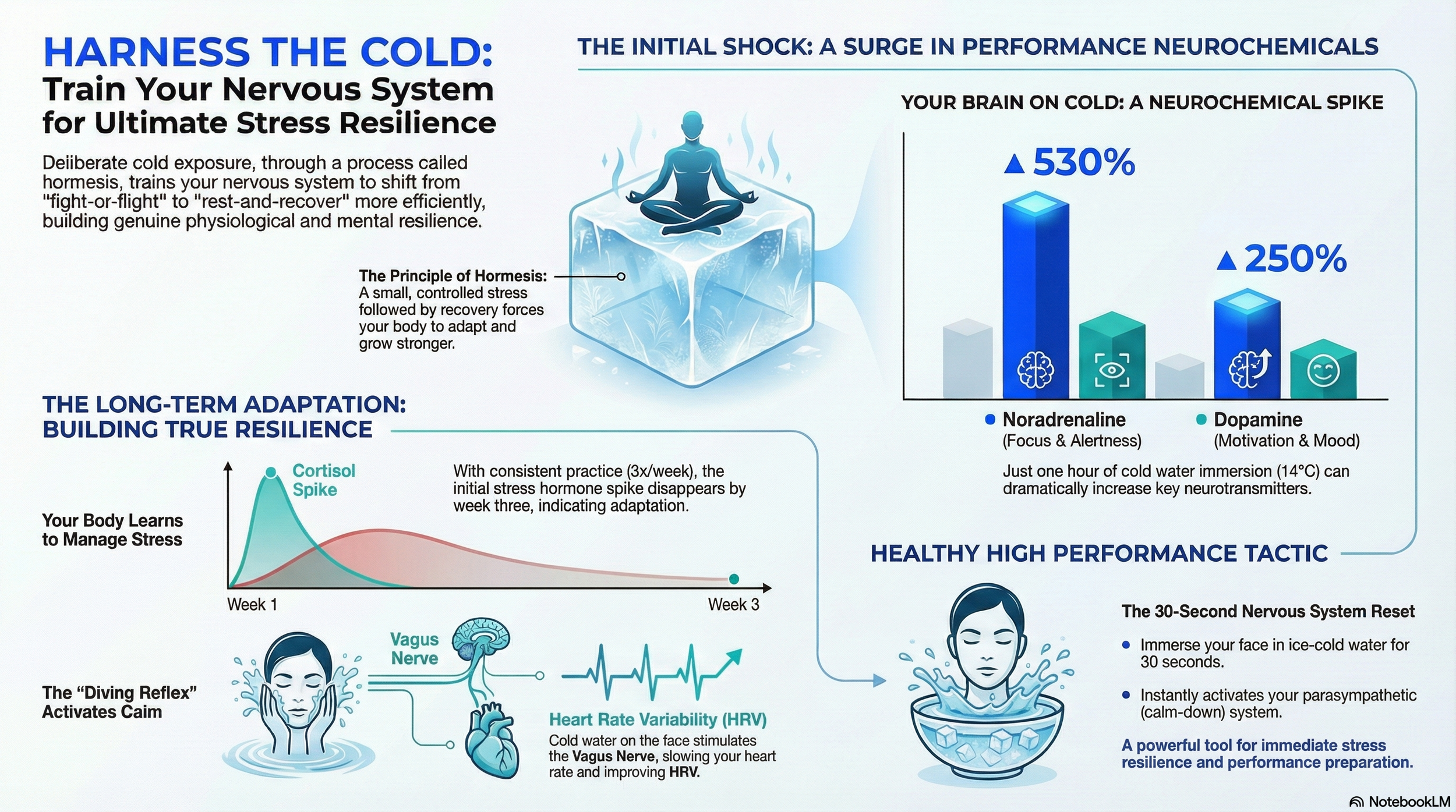
But there is actually more to cold water immersion than exercise recovery and immune responses. Cold exposure teaches your body resilience through a scientifically validated principle called hormesis: a small, controlled stress, followed by recovery, leads to adaptation and improved stress resilience [6]. The same principle applies to exercise, fasting, and heat therapy. A little stress is good (in this case, in the form of exposure to cold), but a lot of stress is not.
What Happens to Your Mind and Body During Cold Water Immersion
The moment cold water hits your skin, your body launches into action. Your sympathetic nervous system activates, triggering what researchers call the "cold shock response": rapid breathing, increased heart rate, and a spike in noradrenaline. This neurotransmitter heightens alertness, sharpens focus, and has anti-inflammatory properties that aid muscle recovery.
In one small study, men in their 20s who underwent one hour of cold-water immersion at 14°C experienced a dramatic neurochemical shift: dopamine concentrations increased by 250% and noradrenaline by 530% [7]. But you don’t need to sit in icy cold water for an hour to benefit from cold water immersion (in fact, I strongly recommend against that). Another small study found that just 5 minutes of whole body immersion (keeping the head out of the water) at 20°C, produced changes in brain connectivity patterns associated with positive changes in mood, affect and attention [8]. Cold water immersion also stimulates the activity of “brown fat”, which burns calories to generate heat, aiding in weight loss [9], [10].
Here's where it gets interesting for stress resilience: young women who participated in 20 second cold plunges (0-2°C) three times per week over a 12 week period showed a striking adaptation pattern. In the first two weeks, cortisol levels spiked before and after each plunge. But by week three, cortisol had dropped substantially and stabilized at or below control levels, and this shift persisted for the remaining nine weeks [11]. The body had adapted. By reducing cortisol production in response to repeated cold stress, participants may also release less cortisol in response to other stressors in everyday life, fostering a more resilient physiological state over time.
How Cold Water Activates the Vagus Nerve and Reduces Stress
The initial response to cold is sympathetic activation. Your heart races. Your breathing quickens. But here's the key: by practicing breathwork in the cold, you can train your parasympathetic nervous system to activate, even under stress. Combining cold-water immersion with breathwork can teach you how to stay calm when challenged.
Cold water activates the vagus nerve through a pathway called the trigeminal-vagal reflex. When cold contacts your face, particularly the forehead and around the eyes, it stimulates the trigeminal nerve, which in turn activates the vagus nerve, producing bradycardia (slowed heart rate) and shifting the body toward parasympathetic dominance – this state is otherwise known as the “diving reflex” [12].
A 2022 study found that vagus activation through facial cold exposure before an acute stressor successfully modified biological stress responses [13]. Cold-water immersion has also been shown to restore impaired vagal-related heart rate variability after intense exercise, essentially resetting the nervous system toward recovery [3].
The mental health implications are significant, but more studies are needed to verify if cold water immersion be used as a treatment for depression and anxiety, with therapies likely needing to be tailored to the individual.
How to Start Cold Water Therapy Safely: A Beginner's Guide
Cold exposure is powerful, but it requires respect. Here's how to begin:
Start with cold showers. Add 30 seconds of cold at the end of your showers for one week. In week two, aim for one minute; week three, two minutes. Your body will slowly build tolerance. Expect it to feel uncomfortable initially. The cold receptors in your skin are the same ones that sense pain. This perception changes as you maintain a consistent practice.
Progress gradually to immersion. Most studies report positive effects after 5 to 20 minutes in water at 10 to 15°C. Take cold showers for 30 days before trying outdoor cold-water immersion to allow your body to acclimate.
Know the risks. Avoid cold-water immersion if you are immunocompromised, have a heart condition or high blood pressure, or have recently recovered from illness. Excessive exposure can induce cardiac stress and hyperventilation. Always bring a buddy for supervision when swimming outdoors, and warm up gradually afterward.
Use breathwork to build tolerance. Techniques like bellows breathing (Mukh Bhastrika) or tum-mo breathing can help you stay calm and increase your tolerance while in the cold. This is exactly what elite practitioners do: they use breath to maintain parasympathetic activation even as the cold challenges their system.
Building Stress Resilience: Breathwork Meets Cold Therapy
You now understand two powerful tools for emotional regulation: breathwork and cold exposure. Both activate the vagus nerve. Both train your nervous system to shift from stress to calm. In the next article, we'll explore how adding in heat (hot-cold contrast therapy) can produce truly transformative results.
1% TIP: THE 30-SECOND FACE IMMERSION RESET
Don't have access to a cold plunge? No problem. Fill a bowl with ice-cold water and immerse your face for 30 seconds. This triggers the diving reflex, a powerful trigeminal-vagal response that slows your heart rate and activates your parasympathetic nervous system almost instantly. It's the fastest nervous system reset available, and you can do it anywhere. Try it before a stressful meeting, after a difficult conversation, or whenever you need to shift from reactive to regulated.
References
[1] O. Almahayni and L. Hammond, “Does the Wim Hof Method have a beneficial impact on physiological and psychological outcomes in healthy and non-healthy participants? A systematic review.,” PLoS One, vol. 19, no. 3, p. e0286933, 2024, doi: 10.1371/journal.pone.0286933.
[2] M. R. M. El-Ansary, A. R. El-Ansary, S. M. Said, and M. A. Abdel-Hakeem, “Regular cold shower exposure modulates humoral and cell-mediated immunity in healthy individuals.,” J. Therm. Biol., vol. 125, p. 103971, Oct. 2024, doi: 10.1016/j.jtherbio.2024.103971.
[3] M. Buchheit, J. J. Peiffer, C. R. Abbiss, and P. B. Laursen, “Effect of cold water immersion on postexercise parasympathetic reactivation,” Am. J. Physiol. Circ. Physiol., vol. 296, no. 2, pp. H421–H427, Feb. 2009, doi: 10.1152/ajpheart.01017.2008.
[4] M. Ihsan et al., “Regular postexercise cooling enhances mitochondrial biogenesis through AMPK and p38 MAPK in human skeletal muscle.,” Am. J. Physiol. Regul. Integr. Comp. Physiol., vol. 309, no. 3, pp. R286-94, Aug. 2015, doi: 10.1152/ajpregu.00031.2015.
[5] J. M. Peake et al., “The Effects of Cold Water Immersion and Active Recovery on Molecular Factors That Regulate Growth and Remodeling of Skeletal Muscle After Resistance Exercise.,” Front. Physiol., vol. 11, p. 737, 2020, doi: 10.3389/fphys.2020.00737.
[6] V. Schirrmacher, “Less Can Be More: The Hormesis Theory of Stress Adaptation in the Global Biosphere and Its Implications.,” Biomedicines, vol. 9, no. 3, Mar. 2021, doi: 10.3390/biomedicines9030293.
[7] P. Srámek, M. Simecková, L. Janský, J. Savlíková, and S. Vybíral, “Human physiological responses to immersion into water of different temperatures.,” Eur. J. Appl. Physiol., vol. 81, no. 5, pp. 436–442, Mar. 2000, doi: 10.1007/s004210050065.
[8] A. Yankouskaya, R. Williamson, C. Stacey, J. J. Totman, and H. Massey, “Short-Term Head-Out Whole-Body Cold-Water Immersion Facilitates Positive Affect and Increases Interaction between Large-Scale Brain Networks.,” Biology (Basel)., vol. 12, no. 2, Jan. 2023, doi: 10.3390/biology12020211.
[9] A. A. J. J. van der Lans et al., “Cold acclimation recruits human brown fat and increases nonshivering thermogenesis,” J. Clin. Invest., vol. 123, no. 8, pp. 3395–3403, Aug. 2013, doi: 10.1172/JCI68993.
[10] S. Søberg et al., “Altered brown fat thermoregulation and enhanced cold-induced thermogenesis in young, healthy, winter-swimming men.,” Cell reports. Med., vol. 2, no. 10, p. 100408, Oct. 2021, doi: 10.1016/j.xcrm.2021.100408.
[11] J. Leppäluoto et al., “Effects of long-term whole-body cold exposures on plasma concentrations of ACTH, beta-endorphin, cortisol, catecholamines and cytokines in healthy females.,” Scand. J. Clin. Lab. Invest., vol. 68, no. 2, pp. 145–153, 2008, doi: 10.1080/00365510701516350.
[12] W. M. Panneton, “The mammalian diving response: an enigmatic reflex to preserve life?,” Physiology (Bethesda)., vol. 28, no. 5, pp. 284–297, Sep. 2013, doi: 10.1152/physiol.00020.2013.
[13] R. Richer, J. Zenkner, A. Küderle, N. Rohleder, and B. M. Eskofier, “Vagus activation by Cold Face Test reduces acute psychosocial stress responses.,” Sci. Rep., vol. 12, no. 1, p. 19270, Nov. 2022, doi: 10.1038/s41598-022-23222-9.