Unplug, Unwind, Unleash: How Solitude Fuels Your Best Ideas
In my last article, I established why creativity is your competitive edge in a world where AI is rapidly taking center stage. Now comes the part that contradicts everything hustle culture teaches you: the way to unlock that creativity is to do less, not more.
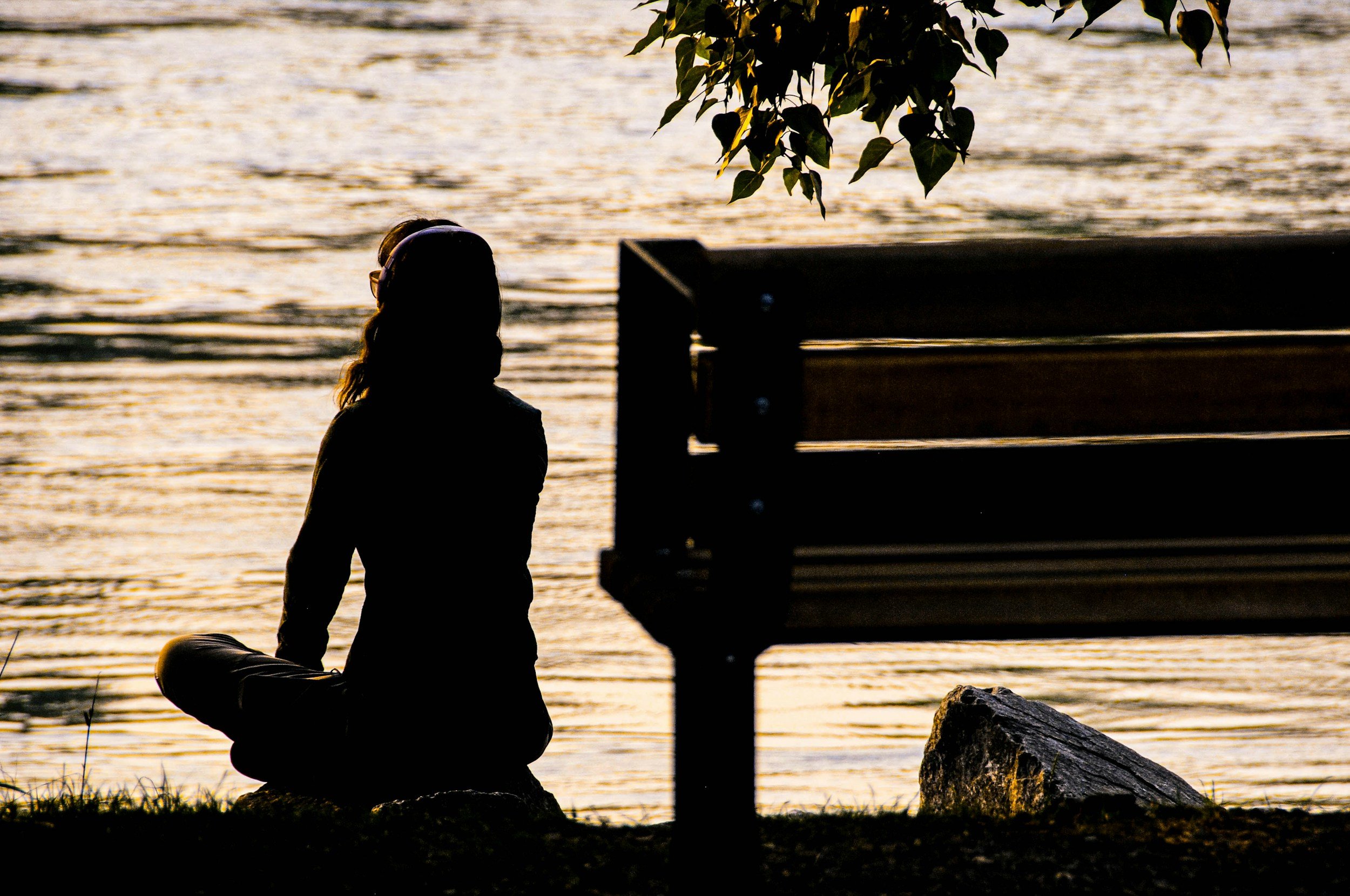
We live in an era of constant stimulation. Notifications ping. Emails stack. Meetings fragment our days. Social media feeds demand our attention. To-do lists grow faster than we can check them off. We've traded boredom for stimulation, silence for noise, and solitude for connectivity. In the process, we've destroyed our capacity to think deeply and crushed our creative spirit.
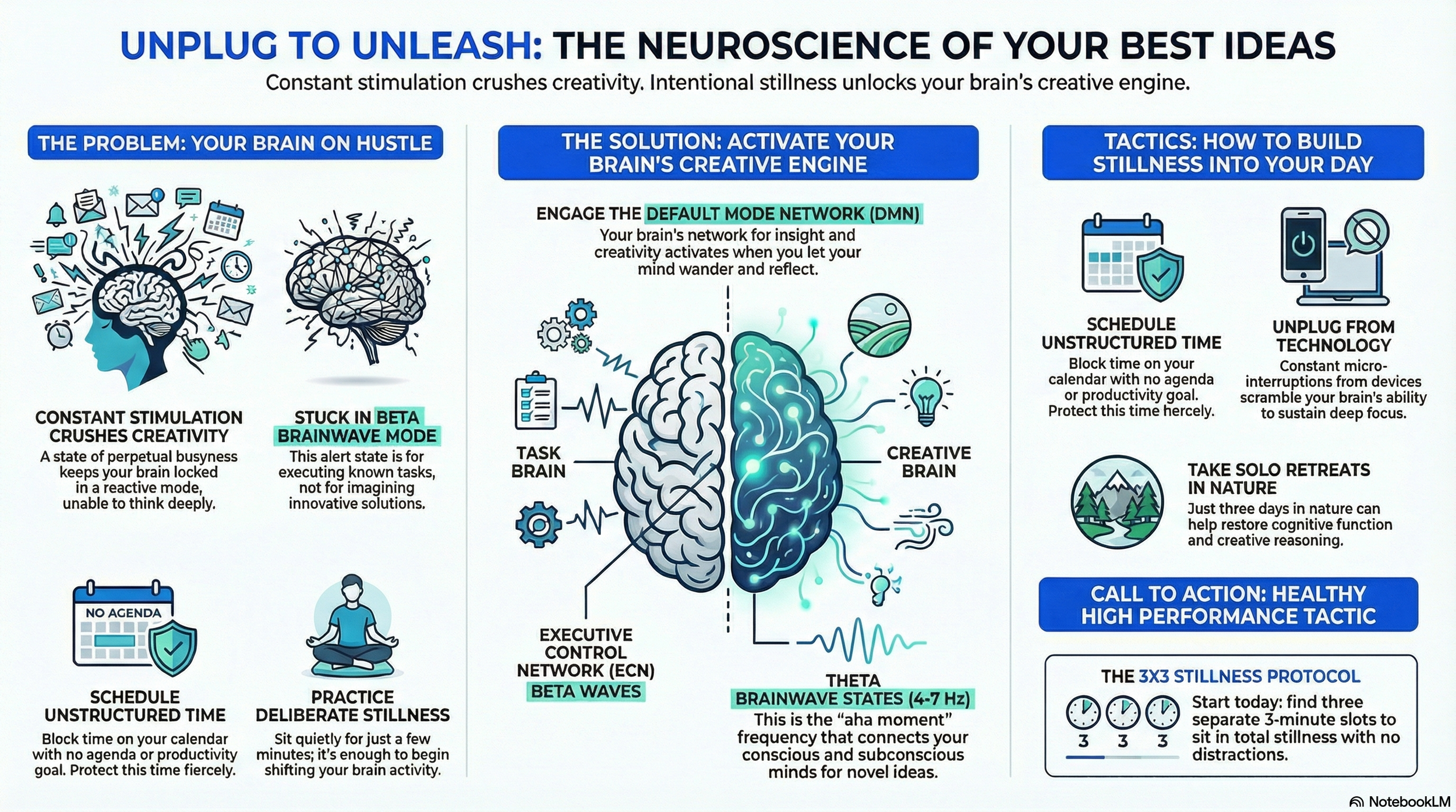
Here is what I've learned: the busier we become, the less creative we actually are. Constant activation keeps the brain locked in beta brainwave mode: alert, reactive, executing tasks. In that state, you can hustle. You can grind. But you cannot imagine. You cannot make unexpected connections. You cannot dream up solutions that don't already exist.
The Default Mode Network: Where Creative Ideas Are Born
Your brain has a network called the default mode network (DMN). It activates when you’re daydreaming, reflecting, or simply letting your mind wander. Peak intuition and creativity flow when DMN activity dominates and your executive control network (ECN) which manages goal-directed behaviour, takes a back seat [1]. This is where the magic happens and inspiration emerges.
But here's the problem: that reflective state gets hijacked during chronic stress, rumination, and anxiety. When you're always on, always reacting, always checking something, the DMN never gets a chance to do its job. The very network responsible for insight, creativity, and problem-solving stays dormant.
Theta Brainwaves: The Creative and Intuitive Sweet Spot
When you enter deep relaxation or sustained daydreaming, your brain shifts into theta brainwave states (4 to 7 Hz). This is where creativity lives. Theta waves connect your conscious and subconscious mind, facilitating the free flow of ideas, memories, and associations that allow you to make novel associations, produce intuitive insights and see breakthrough solutions [2], [3]. This is the neuroscience behind "aha moments"[3].
Think of some of history's greatest creative moments: Paul McCartney waking up with the melody to "Yesterday" fully formed. Scientists solving complex problems in dreams. Entrepreneurs having clarity during walks. Ancient philosophers doing their best thinking while moving through gardens. These weren't random moments of luck. They were theta states—the brain in its optimal creative frequency.
How to Cultivate Solitude and Stillness for Creativity
You don't need a dramatic sabbatical to access this state. Here's how to build it into your life:
Schedule unstructured time. Block it on your calendar and protect it fiercely. Not every hour needs to be optimized. Give yourself permission to have time with no agenda, no productivity goal, no "output."
Create a dedicated creative space. Find a room, a corner, or even a specific chair where your mind learns to enter creative mode. Thomas Edison had his invention factory. Steve Wozniak modeled his creative space after Edison's design. You can do the same on a smaller scale. The space itself becomes a trigger for creativity.
Practice stillness. Sit quietly. Close your eyes. Let your thoughts drift. Don't force meditation if it doesn't appeal to you—just be still. Even a few minutes of stillness can begin to shift your brain activity. Start small and extend your practice over time. Studies on novices undergoing guided meditation found that a 60-minute session resulted in dramatic increases in theta wave production, with many demonstrating altered brainwaves within the first minute [4].
Unplug from technology. Leave your phone in another room. Log off email and social media. The constant micro-interruptions aren't just stealing your time; they're scrambling your brain's ability to enter the sustained attention necessary for real creative thinking. Give yourself permission to be unreachable, at least for a while.
Take solo retreats. Just three days in natural surroundings has been documented to restore brain function and sense of wellness [5]. Even if it's just a day in nature without your devices, stepping away from your normal environment resets your perspective.
From Stillness to Creative Movement and Theta-Driven Insight
You now understand why solitude and stillness are not luxuries but the necessary biological conditions your brain requires to be genuinely creative. In the next article, we'll explore how rhythmic movement, particularly walking, is a powerful complement to stillness. Walking and rhythmic movement activate theta brainwaves in a different way, spark new connections, and deepen empathy, making them essential tools for both individual creativity and collaborative problem-solving.
1% TIP: 3 x 3 MINUTES OF STILLNESS
Start small. Commit to one 3-minute period of stillness today, (or tomorrow if today doesn't work). Sit quietly, close your eyes, and let your mind settle. When your thoughts wander (and they will), notice it without judgment and return to your breath. Then add a second 3-minute block in the evening. Once that becomes habitual, add a third 3-minute block sometime during your day. Three 3-minute periods of solitude, scattered throughout your day, can begin to reset your creative potential. Build from there.
References
[1] C. Huo, C. Li, and K. Ding, “Mapping the brain networks underlying creativity enhancement via aesthetic experience.,” Eur. J. Med. Res., vol. 30, no. 1, p. 968, Oct. 2025, doi: 10.1186/s40001-025-03155-5.
[2] T. V To, D. X. Wang, C. B. Wolfe, and B. C. Lega, “Neurophysiological evidence of human hippocampal longitudinal differentiation in associative memory.,” Nat. Commun., vol. 16, no. 1, p. 6845, Jul. 2025, doi: 10.1038/s41467-025-61464-z.
[3] S. Karakaş, “A review of theta oscillation and its functional correlates.,” Int. J. Psychophysiol. Off. J. Int. Organ. Psychophysiol., vol. 157, pp. 82–99, Nov. 2020, doi: 10.1016/j.ijpsycho.2020.04.008.
[4] P. Stapleton, J. Dispenza, S. McGill, D. Sabot, M. Peach, and D. Raynor, “Large effects of brief meditation intervention on EEG spectra in meditation novices.,” IBRO reports, vol. 9, pp. 290–301, Dec. 2020, doi: 10.1016/j.ibror.2020.10.006.
[5] R. A. Atchley, D. L. Strayer, and P. Atchley, “Creativity in the Wild: Improving Creative Reasoning through Immersion in Natural Settings,” PLoS One, vol. 7, no. 12, p. e51474, Dec. 2012, [Online]. Available: https://doi.org/10.1371/journal.pone.0051474.