Your Creative Edge: What Humans Have Over AI
AI can write sonnets in seconds, generate thousands of design concepts, code entire applications, and produce images that look like they came from a professional photographer. But is it truly creative? Can it feel heartbreak and transform that raw emotion into a song that makes a stranger cry? Can it dream up a world that has never existed and make you care deeply about it?
Most of the "art" AI generates is highly derivative—a sophisticated remix of existing patterns, not a genuine leap into new territory. Creativity is not a luxury reserved for artists and innovators. It is a superpower that lives in every human, and it has now become your most essential competitive advantage against automation.
The AI Revolution (And What It Can't Replace)
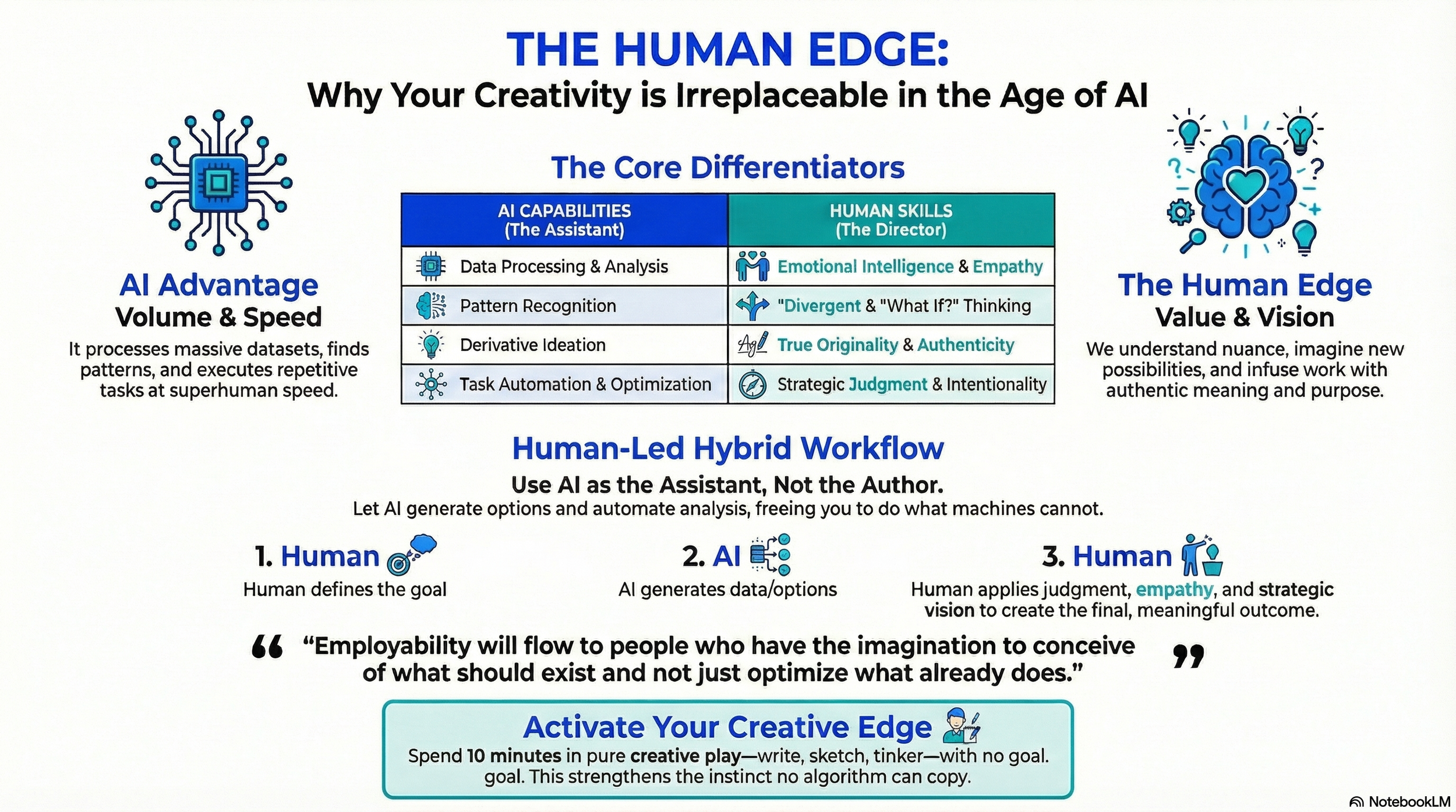
AI is extraordinary at what it was built for: processing massive datasets, finding patterns, executing repetitive tasks, optimizing code, and generating volume at superhuman speed. What it cannot do is feel the weight of a moment and choose the one headline that will pierce through the noise and resonate in someone's chest.
AI lacks emotional intelligence, empathy, and lived experience—the very things that separate derivative from genuinely creative work. It cannot imagine a future it cares about or create something infused with authenticity. AI struggles with the kind of true originality that breaks rules, challenges convention, and creates something that did not exist before because someone dared to imagine differently.
Sure, an AI agent can analyze customer data and identify a gap in the market. But it takes a human to understand the unmet emotional or social need behind that gap and create a product or service that solves a problem people did not even know they had. That intuitive leap, that ability to sense meaning, nuance and possibility, THAT is human creativity.
What Makes Human Creativity Irreplaceable in an AI World
Human creativity flows from the intersection of emotional intelligence, imagination, and intentionality. It is grounded in purpose and meaning, not just data patterns. When you create something authentic like a piece of writing, a design, a business idea, a painting, or a way of solving a problem, you are drawing on your entire life: your successes and failures, your relationships, your values, what you have learned, and what you care about. You are making a choice to create this thing, in this way, for these reasons.
That intentionality in ideation matters. People sense whether something was made by someone who cares or whether it was optimized by an algorithm. We respond most strongly to authenticity, to the fingerprints of a real human grappling with a real problem.
True creativity requires the kind of divergent thinking that questions convention, breaks existing patterns deliberately, and asks "what if?" in ways that feel risky. To create something that is uniquely original requires the ability to see past what is, to what could be. And, most importantly, to imagine multiple possible outcomes and understand the impact of those options based on shared values, compassion and empathy. That is fundamentally different from what AI does, no matter how sophisticated the model.
Creativity in 2026 Is a Team Sport
The smartest approach is not AI versus humans but AI with humans. Let AI handle what it does brilliantly: sorting through mountains of data, generating multiple options, automating analysis, finding correlations, and building the technical infrastructure. Free up human intelligence to do what machines cannot: imagine, strategize, judge what matters, decide what is worth building, and infuse work with genuine meaning and emotion.
In this hybrid model, AI becomes the patient assistant, and humans remain the creative directors. A researcher uses AI to examine thousands of options, but applies their expertise to define what matters, guide the search, and judge which findings are truly significant. A writer uses AI to research and outline, then brings their own voice, emotional truth, and narrative instinct to the work. A strategist uses AI to model scenarios, then applies wisdom and intuition to decide what path to take.
This is not compromise. This is leveraging each system's strengths. The result is faster and smarter, but it succeeds because its foundation is human creativity and empathy.
Why Creativity and Empathy Matter More Than Ever
As routine work gets automated, what remains and cannot be easily replaced is creativity, empathy, and adaptability. These are the soft skills that depend on complex human capacities: the ability to understand what others feel, to see problems from multiple angles, to adapt to novelty, to generate ideas that have never existed before, and to choose directions based on values and purpose, not just efficiency.
Creativity is the foundation of problem-solving. In a world of accelerating change and novel challenges, the ability to think creatively is the ability to solve problems that matter.
In the job market of the next decade, employability will flow to people who have the imagination to conceive of what should exist and not just optimize what already does. The leaders of tomorrow won’t be those who optimize systems. They’ll be those who build teams that use creative thinking to discover what people didn't know they needed and deliver it with genuine authenticity and meaning.
Creativity, empathy, and imagination are not nice-to-have extras. They are the core capacities that keep you relevant, employable, and able to thrive in an AI-saturated world. Perhaps most importantly, being creative, feeling those ideas flow, seeing how our ideas and passion connect with others, is one of the most powerful and enjoyable aspects of being human.
How Do We Unlock Creativity in the Age of AI?
The secret to creativity is counterintuitive: you cannot force creativity. You have to create the conditions where it naturally emerges. That means solitude, stillness, and space for unstructured thinking and quiet observation. In the next article, I’ll explain the optimal conditions for unleashing your creative spark.
1% TIP: LOSE YOURSELF IN THE MOMENT
Today, spend 10 minutes fully absorbed in something you create just for yourself—writing, sketching, tinkering, improvising—without any goal of sharing, optimizing, or producing something "good." That brief immersion in pure creative play strengthens your capacity to imagine, experiment, and trust your instincts. That is the human edge no algorithm can copy.