
Cold exposure has become a popular wellness practice in recent years. Regular exposure to cold, whether through cold showers, ice baths, or winter swims, offers a wide range of health benefits. Key to its positive effects is the activation of the parasympathetic nervous system, which promotes relaxation, mental clarity, and overall well-being. This article explores the science behind cold exposure and its effects on your body and mind.
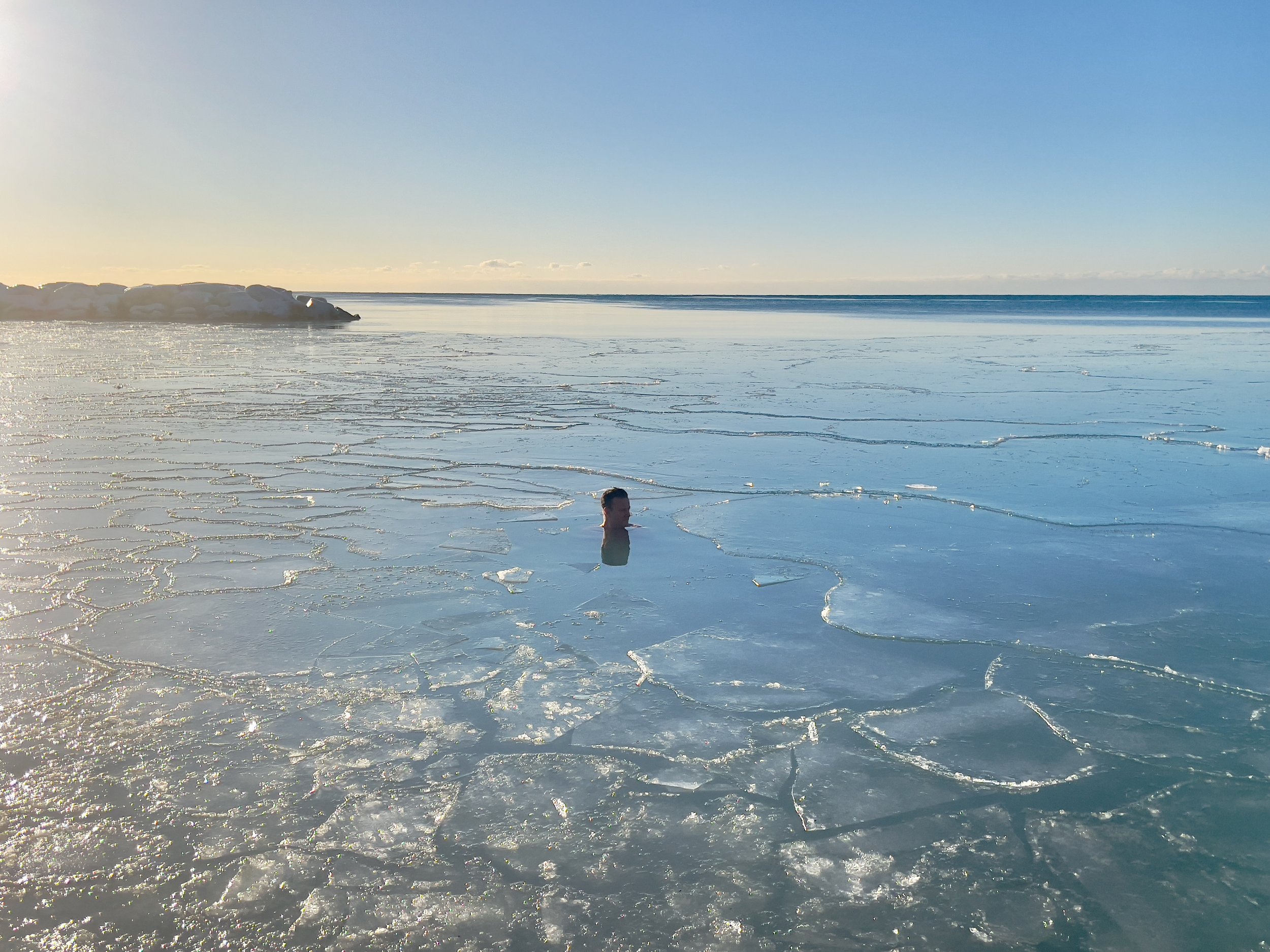
Cold Exposure and the Parasympathetic Nervous System
Cold exposure initially activates the sympathetic nervous system, which is responsible for the body's fight-or-flight response. This explains the initial shock and rapid breathing you feel when you step into cold water [1]. With continued exposure, the parasympathetic nervous system, responsible for rest, digestion, and relaxation, begins to engage: after exercise, 15 minutes in 15°C water sped the return of parasympathetic activity, while hot water slowed it [2]. This shift from sympathetic to parasympathetic activation helps to lower your stress levels and calm your mind.
Cold also switches on cold shock proteins: in mice, cooling raised a cold shock protein called RBM3 that helped the brain rebuild its connections [3]. Cold exposure also raises norepinephrine, a neurotransmitter and hormone involved in mood, attention and focus: in one study, an hour in 14°C water raised blood levels of norepinephrine by more than 500% [4].
Benefits of Cold Exposure for Health
Cold exposure provides a range of health benefits, from enhanced mental clarity to faster physical recovery. Here are some key ways it can support wellness:
Improved Mental Focus and CalmnessWhen you are exposed to cold, your body releases norepinephrine [4], which plays a role in attention, focus, mental clarity and mood. That is why a short cold shower before a demanding day can help sharpen your focus.
Enhanced Recovery and Reduced Inflammation
Cold exposure is commonly used by athletes for its ability to reduce muscle soreness and inflammation. A Cochrane review found that cold-water immersion after exercise reduces muscle soreness over the following four days compared with rest [5]. Cold works by lowering the temperature of your muscle tissue, which slows blood flow, swelling and metabolism in the muscle, as our research review describes [6].Boosted Immune Function
Regular exposure to cold has been associated with improved immune function. In a trial of more than 3,000 adults, people who ended their daily shower with 30 to 90 seconds of cold for a month took 29% fewer sick days from work [7]. Cold also mobilizes your immune cells: in one study, two hours in cold air raised white blood cell and natural killer cell counts [8].
You can read our research review on cold-water immersion here [6].
Incorporating Cold Exposure into Your Routine
Starting with small steps can make cold exposure easier and more enjoyable. Here’s how to safely add cold therapy into your wellness routine:
Begin with Cold Showers
Start by adding 30 seconds of cold water at the end of your regular shower, gradually working up to a full minute or more. Over time, your tolerance will improve, making cold showers feel more invigorating than challenging.Try Cold-Water Immersion
For those seeking a more advanced approach, try cold-water immersion in a bathtub or natural body of water. Most studies report benefits after 5 to 20 minutes in water at 10°C to 15°C; start at the short end and gradually extend the duration as your body adapts. Never go into cold water alone, especially natural bodies of water like lakes, ponds or oceans: the initial cold shock is the main danger for people new to cold water [9].Alternate with HeatIf you’re comfortable with both cold and heat exposure, consider alternating between the two. Switching between hot and cold environments (like a sauna and cold plunge) provides an extra boost to circulation and promotes relaxation. Regular sauna bathing is also linked with better heart health: in a study of more than 2,000 Finnish men followed for about 20 years, those who used a sauna four to seven times a week had about half the risk of dying from cardiovascular disease of those who went once a week [10].
Conclusion: The Cold as a Pathway to Calm and Focus
Cold exposure, when approached mindfully and safely, is an effective way to support health and wellness. By activating the parasympathetic nervous system, this practice can enhance our physical, mental, and emotional well-being. Start small, stay consistent, and use cold as a tool for long-term Healthy High Performance.
This article is based on my Powerhouse book. If you want to learn more about healthy peak performance you can order the book here.
References
[1] M. J. Tipton, N. Collier, H. Massey, J. Corbett, and M. Harper, “Cold water immersion: kill or cure?,” Exp. Physiol., vol. 102, no. 11, pp. 1335-1355, Nov. 2017, doi: 10.1113/EP086283.
[2] V. de Oliveira Ottone et al., “The effect of different water immersion temperatures on post-exercise parasympathetic reactivation,” PLoS One, vol. 9, no. 12, p. e113730, Dec. 2014, doi: 10.1371/journal.pone.0113730.
[3] D. Peretti et al., “RBM3 mediates structural plasticity and protective effects of cooling in neurodegeneration,” Nature, vol. 518, no. 7538, pp. 236-239, Feb. 2015, doi: 10.1038/nature14142.
[4] P. Šrámek, M. Šimečková, L. Janský, J. Šavlíková, and S. Vybíral, “Human physiological responses to immersion into water of different temperatures,” Eur. J. Appl. Physiol., vol. 81, no. 5, pp. 436-442, Mar. 2000, doi: 10.1007/s004210050065.
[5] C. Bleakley, S. McDonough, E. Gardner, G. D. Baxter, J. T. Hopkins, and G. W. Davison, “Cold-water immersion (cryotherapy) for preventing and treating muscle soreness after exercise,” Cochrane Database Syst. Rev., no. 2, p. CD008262, Feb. 2012, doi: 10.1002/14651858.CD008262.pub2.
[6] G. E. White and G. D. Wells, “Cold-water immersion and other forms of cryotherapy: Physiological changes potentially affecting recovery from high-intensity exercise,” Extreme Physiol. Med., vol. 2, no. 1, p. 26, Sep. 2013, doi: 10.1186/2046-7648-2-26.
[7] G. A. Buijze, I. N. Sierevelt, B. C. J. M. van der Heijden, M. G. Dijkgraaf, and M. H. W. Frings-Dresen, “The effect of cold showering on health and work: A randomized controlled trial,” PLoS One, vol. 11, no. 9, p. e0161749, Sep. 2016, doi: 10.1371/journal.pone.0161749.
[8] I. K. M. Brenner et al., “Immune changes in humans during cold exposure: Effects of prior heating and exercise,” J. Appl. Physiol., vol. 87, no. 2, pp. 699-710, Aug. 1999, doi: 10.1152/jappl.1999.87.2.699.
[9] B. Knechtle, Z. Waśkiewicz, C. V. Sousa, L. Hill, and P. T. Nikolaidis, “Cold water swimming, benefits and risks: A narrative review,” Int. J. Environ. Res. Public Health, vol. 17, no. 23, p. 8984, Dec. 2020, doi: 10.3390/ijerph17238984.
[10] T. Laukkanen, H. Khan, F. Zaccardi, and J. A. Laukkanen, “Association between sauna bathing and fatal cardiovascular and all-cause mortality events,” JAMA Intern. Med., vol. 175, no. 4, pp. 542-548, Apr. 2015, doi: 10.1001/jamainternmed.2014.8187.
