In my last two articles, I detailed how breath controls your nervous system and how cold exposure builds stress resilience. Now, let's explore the synergistic power of combining heat AND cold to create thermal contrast cycles that amplify emotional regulation, deepen breath mastery, and build a nervous system capable of handling both intense stress and profound calm.
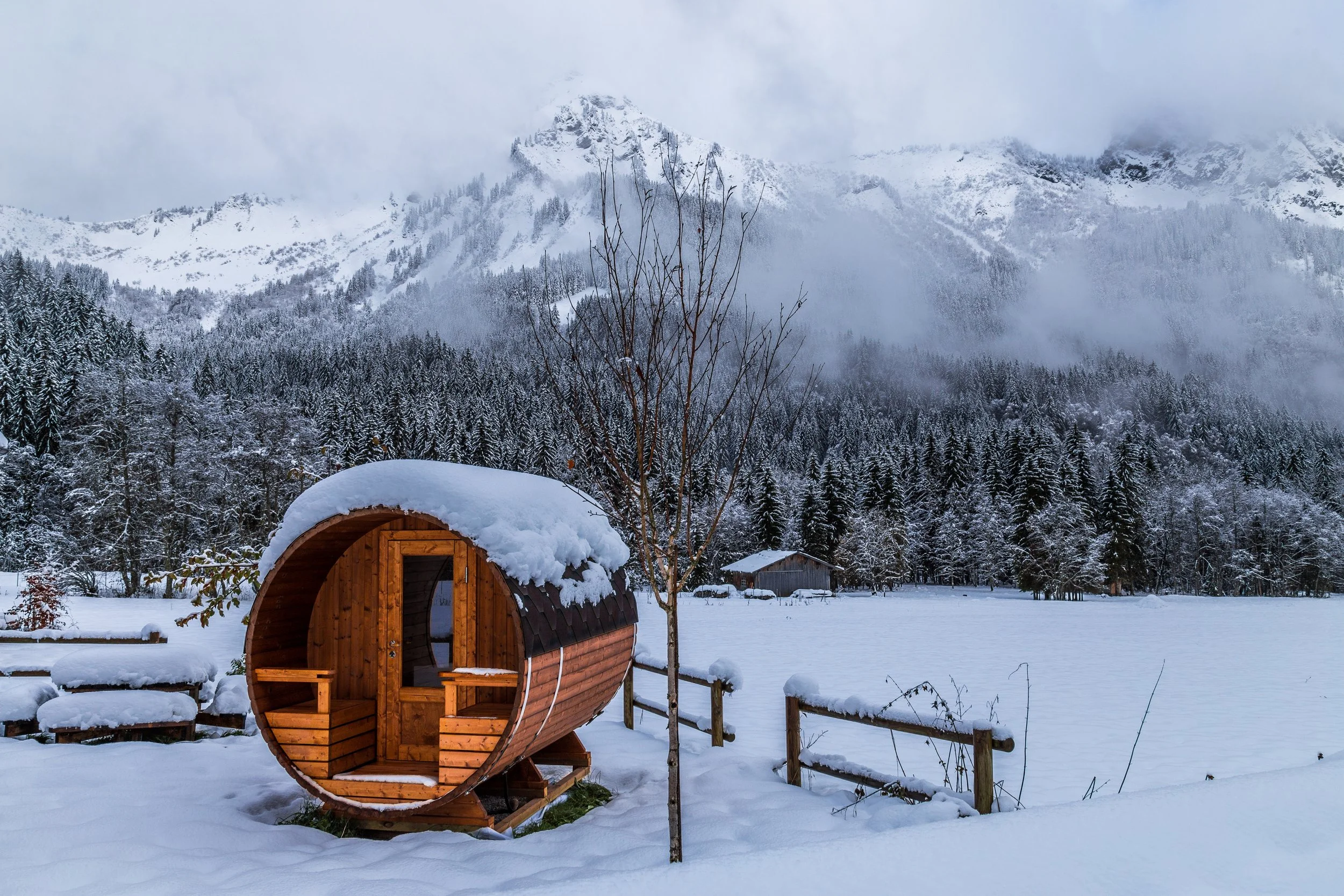
Sauna Benefits: How Heat Activates Emotional Calm and Recovery
There are many modes of heat therapy, otherwise known as whole body hyperthermia (WBH), including dry sauna, wet sauna, infrared saunas and spa/hot tubs. Typical therapeutic ranges are 80-100°C for dry (Finnish-style) saunas, 70-90°C for wet saunas, and 39-42°C for hot tubs/spas. For therapeutic benefits, the goal is to elevate your core body temperature to between 38-38.5°C, which can typically be achieved in about 15-20 minutes of exposure [1]. Because water-immersion elevates core body temperature faster, temperatures can be much lower than in traditional saunas.
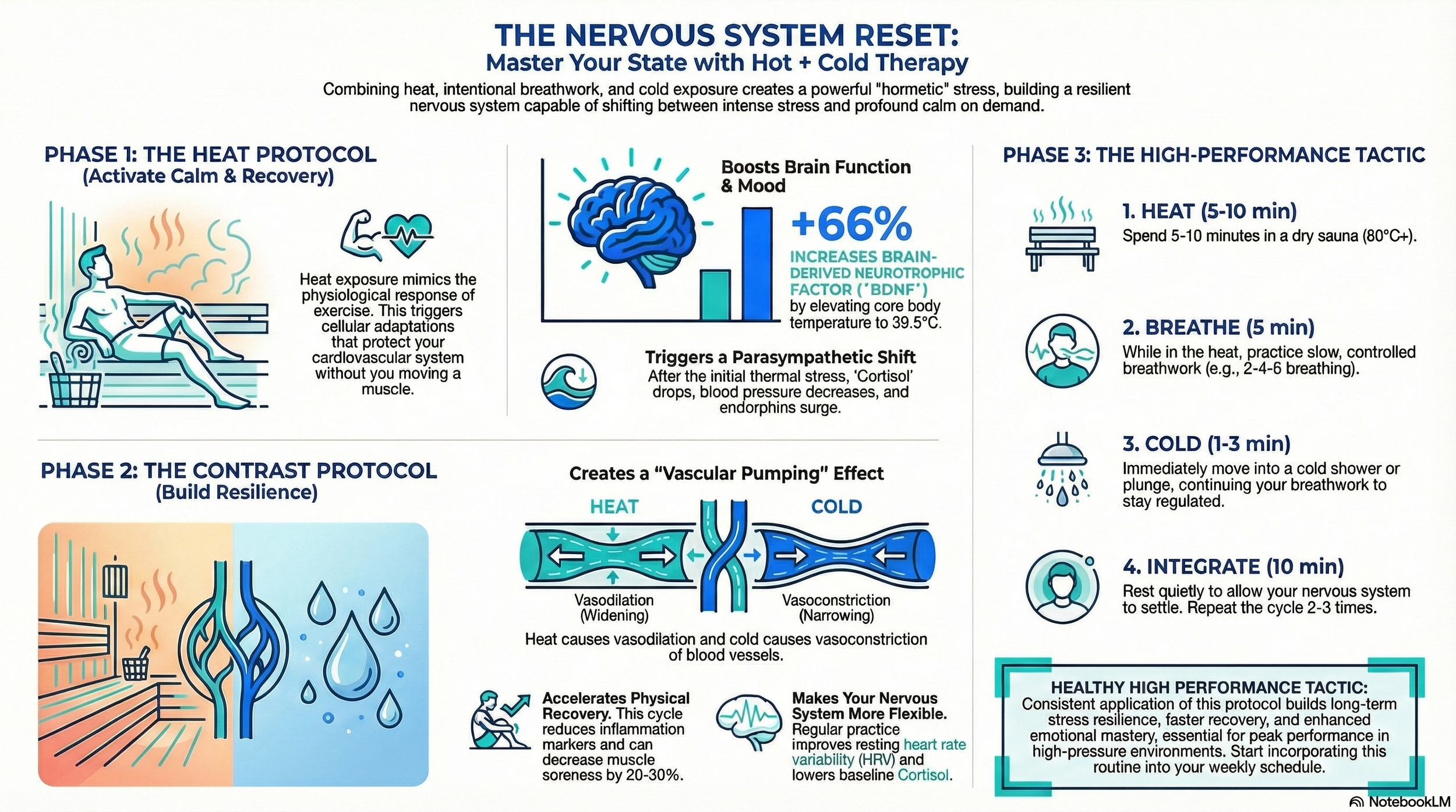
When your body experiences this controlled thermal stress, it mirrors the physiological response of exercise. Heat shock proteins activate, triggering cascading cellular adaptations that protect your cardiovascular system. HSPs increase nitric oxide production in blood vessels (keeping arteries relaxed and flexible), reduce oxidative stress, and strengthen arterial walls [1]. Remarkably, this happens passively, without you moving a muscle.
The cardiovascular evidence is compelling. A 20-year Finnish study of 2,000+ men found that weekly sauna use (15+ minutes) significantly reduced cardiovascular disease risk and mortality, with stronger benefits at higher frequencies (4-7 times weekly) [2]. A similar study with 1,600+ men and women confirmed this dose-response effect [3].
Mental health benefits are equally striking. Elevating core body temperature to 39.5°C increased brain-derived neurotrophic factor (BDNF) by 66%—the neurochemical crucial for neuroplasticity and mood regulation [4]. Low BDNF is linked to depression while elevated BDNF supports neuroplasticity and emotional resilience. Multiple randomized trials found that regular heat exposure significantly reduced depressive symptoms, with larger treatment effects seen in those who achieved a core body temperature of 38-39°C more slowly [5], and a single infrared sauna session producing effects that persisted for six weeks [6].
Then comes the emotional shift: after initial heat stress, your parasympathetic nervous system activates. Cortisol drops. Blood pressure decreases by 5-10 mmHg. Endorphins surge. It’s physiological reset toward calm and recovery.
Sauna Breathwork: The Emotional Regulation Loop for Stress Resilience
The real magic happens when you combine heat exposure with intentional breathwork. Practice slow, intentional breathing (try the 2-4-6 technique or box breathing from my earlier article) as you acclimate to the heat.
Here’s why this matters: intense heat naturally triggers hyperventilation and increases CO2 in your bloodstream. Controlled, diaphragmatic breathing in the sauna does the opposite: it activates your parasympathetic nervous system, lowers blood pressure, and creates a neurological imprint that carries into daily life. You're rewiring your nervous system's stress response capacity while remaining calm in a thermal challenge.
The Power of Contrast: How Hot-to-Cold Transitions Build Resilience
Now, introduce the cold. After 10-20 minutes of heat and breathwork, step into a cold shower or plunge (12-14°C for 1-3 minutes). This creates a powerful hormetic stress that trains your nervous system to handle rapid transitions between extreme states.
In my last article, I talked about the physiology of your body’s response to cold. Contrast therapy creates a "vascular pumping" effect: vasodilation from heat, then vasoconstriction from cold, then vasodilation again [7]. This alternating action induces intermittent changes in peripheral blood vessels that increase tissue blood flow, oxygenation, and waste-product transportation. Research shows that alternating heat and cold stimulation affects heart rate variability parameters, indicating changes in autonomic nervous activity. Repeated heat-cold cycles have been shown to reduce inflammation markers, decrease muscle soreness by 20-30%, improve tissue perfusion, and accelerate recovery [7], [8], [9].
The adaptation is profound. After weeks of regular contrast cycles, your resting heart rate variability improves, your baseline cortisol decreases, and your nervous system becomes more flexible—capable of shifting between activation and calm on demand.
Building Emotional Mastery Through Sauna and Cold Exposure
This is where emotional mastery emerges. Mindfulness through temperature extremes builds genuine emotional resilience: the ability to feel intensity—heat, cold, stress, fear—and respond with calm, controlled breathing and awareness rather than reactivity.
Each time you step into a sauna, practice breathwork, and transition into cold water, you're rehearsing emotional regulation in real time. You're teaching yourself that discomfort doesn't require panic. That intensity doesn't require loss of control. That you can remain present and regulated in challenging states.
This transfers beyond the sauna. The nervous system adaptation that emerges from thermal contrast generalizes to other stressors. Your body learns resilience at the cellular, neurological, and psychological levels simultaneously.
The Complete Nervous System Toolkit: Breathwork, Heat, and Cold
Emotional mastery begins with breathwork, deepens through cold exposure resilience, and becomes transformative through thermal contrast cycles. By combining heat exposure, intentional breathwork, and cold immersion, you build a complete nervous system toolkit for emotional regulation that works at every level: cellular (HSP activation, mitochondrial adaptation), neurological (BDNF elevation, parasympathetic dominance), and psychological (stress inoculation, present-moment awareness).
1% TIP: YOUR CONTRAST + BREATHWORK PROTOCOL
The foundation for maximum effect is consistency and intentional sequencing. Spend 5-10 minutes in dry heat (80°C or higher), then practice 5 minutes of breathwork (2-4-6 breathing) while still in the sauna. Move immediately into a cold shower or plunge for 1-3 minutes, practicing the same breathwork to stay regulated. Finally, spend 10 minutes in meditation or quiet rest to integrate the experience and allow your nervous system to settle. You can repeat this cycle 2-3 times if time permits. The more frequently you practice (2-7 times per week), the greater the cardiovascular, emotional, and metabolic benefits.
References
[1] V. E. Brunt and C. T. Minson, “Heat therapy: mechanistic underpinnings and applications to cardiovascular health.,” J. Appl. Physiol., vol. 130, no. 6, pp. 1684–1704, Jun. 2021, doi: 10.1152/japplphysiol.00141.2020.
[2] T. Laukkanen, H. Khan, F. Zaccardi, and J. A. Laukkanen, “Association Between Sauna Bathing and Fatal Cardiovascular and All-Cause Mortality Events,” JAMA Intern. Med., vol. 175, no. 4, pp. 542–548, Apr. 2015, doi: 10.1001/jamainternmed.2014.8187.
[3] T. Laukkanen, S. K. Kunutsor, H. Khan, P. Willeit, F. Zaccardi, and J. A. Laukkanen, “Sauna bathing is associated with reduced cardiovascular mortality and improves risk prediction in men and women: a prospective cohort study.,” BMC Med., vol. 16, no. 1, p. 219, Nov. 2018, doi: 10.1186/s12916-018-1198-0.
[4] D. Kojima et al., “Head-out immersion in hot water increases serum BDNF in healthy males,” Int. J. Hyperth., vol. 34, no. 6, pp. 834–839, Aug. 2018, doi: 10.1080/02656736.2017.1394502.
[5] K.-U. Hanusch and C. W. Janssen, “The impact of whole-body hyperthermia interventions on mood and depression – are we ready for recommendations for clinical application?,” Int. J. Hyperth., vol. 36, no. 1, pp. 572–580, Jan. 2019, doi: 10.1080/02656736.2019.1612103.
[6] C. W. Janssen et al., “Whole-Body Hyperthermia for the Treatment of Major Depressive Disorder: A Randomized Clinical Trial.,” JAMA psychiatry, vol. 73, no. 8, pp. 789–795, Aug. 2016, doi: 10.1001/jamapsychiatry.2016.1031.
[7] B. Shadgan, A. H. Pakravan, A. Hoens, and W. D. Reid, “Contrast Baths, Intramuscular Hemodynamics, and Oxygenation as Monitored by Near-Infrared Spectroscopy.,” J. Athl. Train., vol. 53, no. 8, pp. 782–787, Aug. 2018, doi: 10.4085/1062-6050-127-17.
[8] G. Ravier, P. Marcel-Millet, C. Fostel, and E. Baradat, “Post-Exercise Cold- and Contrasting-Water Immersion Effects on Heart Rate Variability Recovery in International Handball Female Players.,” J. Hum. Kinet., vol. 81, pp. 109–122, Jan. 2022, doi: 10.2478/hukin-2022-0010.
[9] D. J. Cochrane, “Alternating hot and cold water immersion for athlete recovery: a review,” Phys. Ther. Sport, vol. 5, no. 1, pp. 26–32, 2004, doi: https://doi.org/10.1016/j.ptsp.2003.10.002.