The Neuroscience of Flow States—Your Brain in the "Zone"
In our previous article, we showed why rest is required for peak performance; true growth occurs when stress meets recovery. Those moments of restoration lay the groundwork for flow – a state where focus, skill, and creativity combine for extraordinary results.

What Is Flow State? The Psychology of "The Zone"
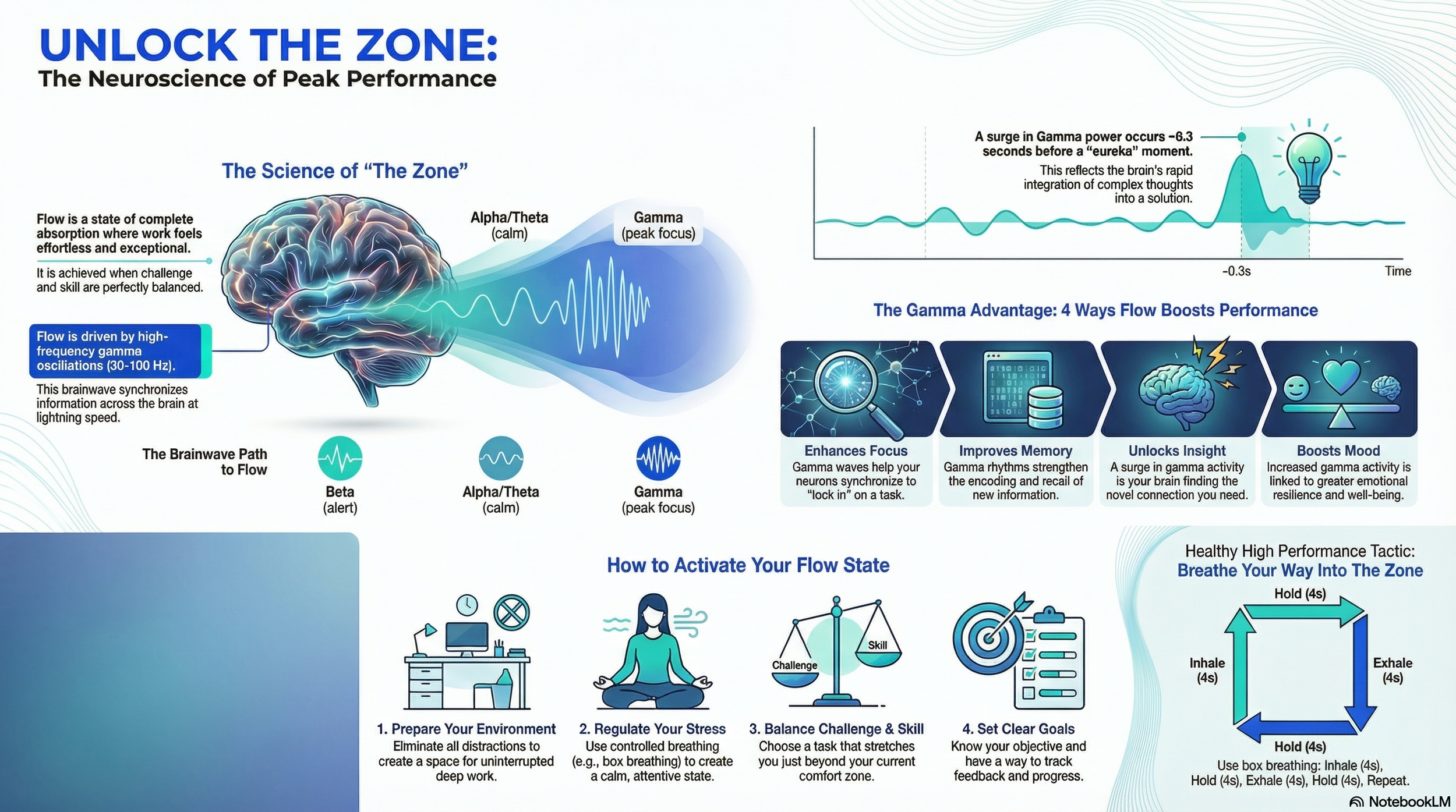
Flow, (also known as “being in the zone”) described by Mihaly Csikszentmihalyi, is complete absorption in the present task: you lose sense of time and self, and work or play feels both effortless and exceptional. Research identifies key flow conditions: a balance between challenge and skill, clear goals, immediate feedback, deep focus, and intrinsic reward [1].
The Neuroscience of Flow
Flow isn't just a feeling, it's a distinct brain state characterized by increased theta activity in frontal areas (linked to deep focus) and moderate alpha activity (calm alertness). This foundational state creates the cognitive conditions necessary for sustained concentration and performance.
Within this flow state, gamma oscillations (30-100 Hz) facilitate rapid information integration and emerge particularly during moments of creative breakthrough [2]. Research consistently shows that gamma power suddenly increases in the right temporal lobe just before "eureka" moments in problem-solving, approximately 0.3 seconds before we consciously recognize a solution [3], [4]. These gamma bursts sweep through the brain, synchronizing information from multiple regions and enabling the sudden integration of complex thoughts at lightning speed [5].
Gamma oscillations are tied to high-level cognitive functions: linking perception, memory, attention, and problem-solving [6]. This is why experienced meditators, musicians, and athletes in flow consistently demonstrate elevated gamma activity—it reflects the brain's ability to rapidly bind together disparate information and access peak performance [7].
How Gamma Brainwaves Enhance Focus and Creativity
· Enhance focus/concentration: When I talk about focus, I’m talking about what’s happening in your brain at a fundamental, electrical level. Gamma-band activity is basically your brain’s way of locking in. When you truly focus (whether you’re in a race or a writing sprint) your neurons literally synchronize, helping you tune out the noise and dial in on what matters most. Gamma is your brain’s signal booster for attention in action.
· Improve memory and learning: Gamma rhythms strengthen the encoding and recall of memories [8]. When you're deeply engaged and truly present in what you're doing, gamma rhythms kick in and cement those experiences into memory. It's the difference between passively reading something and actively learning it.
· Unlock insights: Here's where it gets interesting. Just before that "eureka" moment when a solution suddenly crystallizes, gamma activity surges in your brain. It's like watching the exact moment your neural networks find the connection you've been searching for. That's gamma at work.
· Boost mood and well-being: Gamma doesn't just sharpen your mind, it lifts your mood [9]. When gamma activity increases, you experience greater emotional resilience, more mental flexibility, and the sense of well-being that comes with being fully engaged. That positive feeling when you're in flow? That's partly your brain's gamma response.
Rest and recovery are essential precursors to peak gamma activation. The brain shifts from beta (alert) to alpha/theta (calm, creative) before reaching the heightened energy and synchrony of a gamma-dominated “peak experience” state.
How to Get Into Flow State: Practical Techniques
· Prepare your environment: Eliminate distractions. Allow for deep work blocks where focus won’t be disrupted.
· Regulate stress: Use breathing (box breathing, long exhales) to manage arousal and create a calm, attentive state.
· Balance challenge and skill: Choose tasks that stretch, but don’t overwhelm, your current abilities. Flow occurs in the “sweet spot” just beyond your comfort zone.
· Set clear, achievable goals: Know what you’re working toward, and ensure feedback is present throughout, so you can adjust and stay engaged.
· Practice regularly: The more you practice accessing flow, the easier it becomes for your brain to shift into gamma-dominated states on demand.
Flow State Examples: Musicians, Athletes and Writers
Athletes describe “everything slowing down” during key games. Jazz musicians improvise without conscious thought, and writers are “lost” in their work for hours. Imaging studies confirm that, during such times, gamma waves surge and executive control regions dial down, allowing creative skills to emerge naturally [10], [11].
Why Rest and Recovery is Essential for Accessing Flow
You can’t access flow when depleted. Rest supports the alpha and theta states that precede gamma, and only from this baseline can you achieve deep, creative focus. Skipping recovery short-circuits performance, causing you to “force it” and breaking the natural rhythm of flow.
The Takeaway: Flow Is a Skill You Can Master
Flow is the brain’s highest-performance mode where creativity and productivity merge. Rest and preparation are prerequisites: by cycling stress with recovery, designing distraction-free work environments, and consistently practicing your craft, you enable your brain to reach this optimal zone.
In our next article, we’ll explore how to manage distractions and sustain focus, making high productivity states a habit rather than a fluke.
1% TIP: BREATHE YOUR WAY INTO THE ZONE
Flow is the brain’s highest-performance mode where creativity and productivity merge. Rest and preparation are prerequisites: by cycling stress with recovery, designing distraction-free work environments, and consistently practicing your craft, you enable your brain to reach this optimal zone.
When you want to enter “flow,” eliminate distractions, pause and use box breathing: inhale for 4, hold for 4, exhale for 4, hold for 4. Repeat until focus returns and then dive in.
References
[1] M. Csikszentmihalyi, Flow and the Foundations of Positive Psychology The Collected Works of Mihaly Csikszentmihalyi. Dordrecht Springer Netherlands, 2014.
[2] Y. Hang, B. Unenbat, S. Tang, F. Wang, B. Lin, and D. Zhang, “Exploring the Neural Correlates of Flow Experience with Multifaceted Tasks and a Single-Channel Prefrontal EEG Recording.,” Sensors (Basel)., vol. 24, no. 6, Mar. 2024, doi: 10.3390/s24061894.
[3] T. Bieth et al., “Time course of EEG power during creative problem-solving with insight or remote thinking.,” Hum. Brain Mapp., vol. 45, no. 1, p. e26547, Jan. 2024, doi: 10.1002/hbm.26547.
[4] M. Jung-Beeman et al., “Neural Activity When People Solve Verbal Problems with Insight,” PLOS Biol., vol. 2, no. 4, p. e97, Apr. 2004, [Online]. Available: https://doi.org/10.1371/journal.pbio.0020097
[5] C. A. Bosman, C. S. Lansink, and C. M. A. Pennartz, “Functions of gamma-band synchronization in cognition: from single circuits to functional diversity across cortical and subcortical systems.,” Eur. J. Neurosci., vol. 39, no. 11, pp. 1982–1999, Jun. 2014, doi: 10.1111/ejn.12606.
[6] Q. Deng et al., “Mystery of gamma wave stimulation in brain disorders.,” Mol. Neurodegener., vol. 19, no. 1, p. 96, Dec. 2024, doi: 10.1186/s13024-024-00785-x.
[7] C. Braboszcz, B. R. Cahn, J. Levy, M. Fernandez, and A. Delorme, “Increased Gamma Brainwave Amplitude Compared to Control in Three Different Meditation Traditions,” PLoS One, vol. 12, no. 1, p. e0170647, Jan. 2017, [Online]. Available: https://doi.org/10.1371/journal.pone.0170647
[8] K. T. Li, J. Liang, and C. Zhou, “Gamma Oscillations Facilitate Effective Learning in Excitatory-Inhibitory Balanced Neural Circuits.,” Neural Plast., vol. 2021, p. 6668175, 2021, doi: 10.1155/2021/6668175.
[9] R. L. S. Sharpe, M. Mahmud, M. S. Kaiser, and J. Chen, “Gamma entrainment frequency affects mood, memory and cognition: an exploratory pilot study.,” Brain informatics, vol. 7, no. 1, p. 17, Nov. 2020, doi: 10.1186/s40708-020-00119-9.
[10] D. Rosen, Y. Oh, C. Chesebrough, F. (Zoe) Zhang, and J. Kounios, “Creative flow as optimized processing: Evidence from brain oscillations during jazz improvisations by expert and non-expert musicians,” Neuropsychologia, vol. 196, p. 108824, 2024, doi: https://doi.org/10.1016/j.neuropsychologia.2024.108824.
[11] A. Dietrich, “Neurocognitive mechanisms underlying the experience of flow,” Conscious. Cogn., vol. 13, no. 4, pp. 746–761, 2004, doi: https://doi.org/10.1016/j.concog.2004.07.002.