Move to Live Longer and Better: The Science of Healthspan vs. Lifespan
Picture an 82-year-old woman crushing a 5K run, or a grandfather effortlessly keeping up with his grandchildren at the park. These aren't rare genetic miracles – they're examples of what happens when we prioritize vitality and thriving over merely existing.

Most of us think about longevity in terms of lifespan (how many years we live). But there's another metric that matters far more: healthspan, which is how long we live healthy, free from disease, disability, chronic pain and mental decline. The goal isn't just to blow out more birthday candles; it's to have the energy, strength, and mental clarity to actually enjoy the celebration. By targeting healthspan, we give ourselves the best chance to stay strong, sharp, and independent for as many of those years as possible.
AMPK and mTOR: The Two Pathways That Determine How You Age
Inside your cells right now, two powerful biological pathways are competing for control over how you age. Understanding them changes everything.
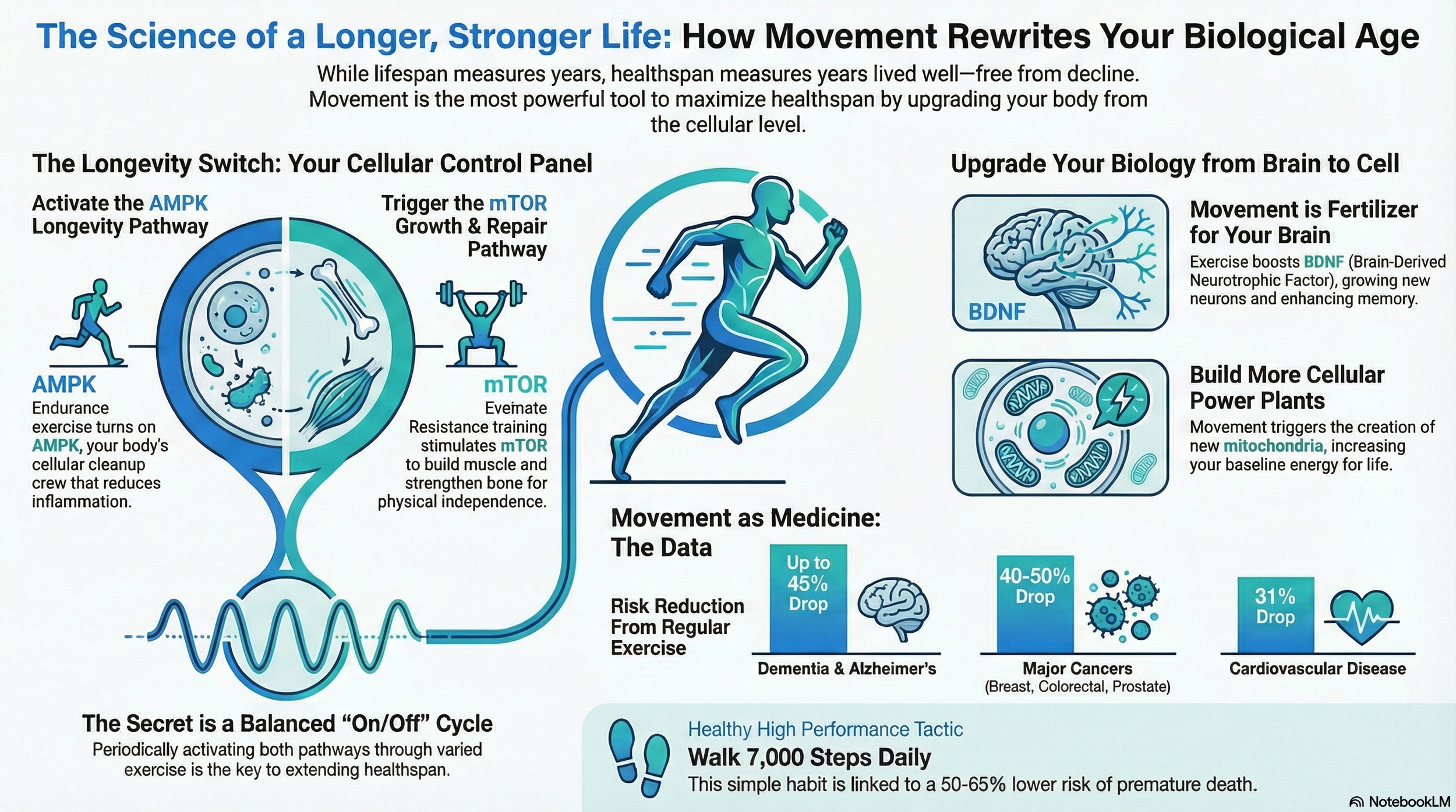
AMPK (AMP-activated protein kinase) is your "longevity pathway". When activated through activities like endurance exercise and intermittent fasting, AMPK helps your cells clean up damaged components, reduces inflammation, and extends lifespan [1], [2]. Think of it as your body's cellular housekeeping system.
mTOR (mechanistic target of rapamycin) is your "growth and repair pathway". Stimulated by resistance training and adequate protein intake, mTOR builds muscle, strengthens bones, and maintains the physical capacity you need to live independently [3,4]. It's your body's construction crew.
Here's the catch: chronic activation of either pathway backfires. Excessive endurance exercise and constant caloric restriction can lead to muscle loss and frailty. Conversely, overfeeding and sedentary living accelerate aging, inflammation, and disease.
The sweet spot? Periodic activation of both pathways through varied exercise and intelligent nutrition. This is how you extend both lifespan and healthspan.
The Muscle-to-Brain Connection: Your Secret Weapon
When you move your body, something remarkable happens in your brain. Exercise and brain health are directly linked through the protein, brain-derived neurotrophic factor (BDNF). Exercise of any kind, including walking, induces the production of BDNF, and it acts like fertilizer for your brain cells [5,6]. BDNF stimulates the growth of new neurons and new neural connections, enhances learning and memory, improves focus, and elevates mood [7].
Movement literally changes your brain's structure, particularly in the hippocampus (the seat of learning) and cortex [8]. It reduces neuroinflammation, improves sleep quality, and boosts mental health [9]. Movement also slows brain aging. In a study of more than 800 adults over 70, those who had regular physical activity had brain structures and cognitive performance comparable to people a decade younger, relative to those who were sedentary [10].
Movement as Medicine: The Most Powerful Drug You'll Never Take
The research on exercise and longevity is staggering. Regular exercise reduces your risk of dying from breast, colorectal, and prostate cancer by 40-50% [11] and cardiovascular disease by 31% [12]. A daily 20-minute walk can reduce your risk of developing type 2 diabetes by 20%, with more physical activity providing even greater risk reduction [13]. A systematic review of 16 studies determined that regular exercise can reduce the risk of developing Alzheimer's and dementia by up to 45%, with as little as 1.5 hours a week of activity helping to preserve cognitive performance [14]. Exercise (particularly load-bearing and resistance training) is also crucial to preventing osteoporosis and sarcopenia (age-related muscle loss) [15].
Even better? You don't need to become a marathon runner. Just 2.5 to 5 hours per week of moderate exercise (from ~20-40 minutes per day), substantially lowers all-cause mortality risk, especially for people who sit a lot.
Mitochondrial Biogenesis: How Exercise Builds Your Cellular Energy System
At the cellular level, movement triggers something called mitogenesis, the creation of new mitochondria, the tiny powerhouses in your cells that produce ATP, the energy currency fueling everything you do. With consistent exercise, you don’t just build more mitochondria; you make existing ones more efficient through a process called mitoplasticity, and research shows it is never too late to start [16]! A study of 20 men with burnout who exercised just 3 hours weekly for 12 weeks saw reduced depressive symptoms, increased mitochondrial function, and elevated ATP levels [17].
What does movement buy us? More energy for thinking, working, playing, and living. You're not just adding years to your life; you're adding life to your years.
The Path Forward
The beauty of this science is its simplicity. You don't need expensive equipment, elite coaching, or genetic advantages. You need consistency. Walk. Swim. Bike. Dance. Garden. Lift weights. Play with your kids. The specific activity matters less than the habit of moving your body regularly. Just 3 minutes of activity each hour (walking or doing 10 squats) ten times per day improves your glucose and insulin response, reducing the risk of developing diabetes [18].
Your future self – the one who climbs stairs without getting winded, plays on the floor with grandchildren, and thinks clearly into their ninth decade – is counting on the choices you make today.
Now that you understand why movement is the foundation of healthspan and longevity, the next article will show you how to use Zone1- 2 cardio to build your aerobic base and activate AMPK.
1% TIP: WALK 7,000 STEPS DAILY TO IMPROVE YOUR HEALTHSPAN AND LONGEVITY
One fascinating study of over 2,000 adults found that walking 7,000 steps or more per day was associated with a 50-65% lower risk of premature death [19]. Not 10,000. Not even 8,000. Just 7,000 steps (which is about 35 minutes of walking) can dramatically improve your health and longevity, and also provide a boost to creative thinking [20]. Even as little as 15 minutes of walking can make a difference [21]. Grab a friend or walking partner, or have a “walking meeting” at work for added benefits – “dual task” exercises like walking and talking integrate multiple neural pathways, improving balance, gait, and cognition in addition to boosting cardio-metabolic health [22].
References
[1] S. Herzig and R. J. Shaw, “AMPK: guardian of metabolism and mitochondrial homeostasis.,” Nat. Rev. Mol. Cell Biol., vol. 19, no. 2, pp. 121–135, Feb. 2018, doi: 10.1038/nrm.2017.95.
[2] F. Kazmirczak et al., “Intermittent Fasting Activates AMP-Kinase to Restructure Right Ventricular Lipid Metabolism and Microtubules,” JACC Basic to Transl. Sci., vol. 8, no. 3, pp. 239–254, 2023, doi: https://doi.org/10.1016/j.jacbts.2022.12.001.
[3] Z. Zeng, J. Liang, L. Wu, H. Zhang, J. Lv, and N. Chen, “Exercise-Induced Autophagy Suppresses Sarcopenia Through Akt/mTOR and Akt/FoxO3a Signal Pathways and AMPK-Mediated Mitochondrial Quality Control.,” Front. Physiol., vol. 11, p. 583478, 2020, doi: 10.3389/fphys.2020.583478.
[4] K. Watson and K. Baar, “mTOR and the health benefits of exercise.,” Semin. Cell Dev. Biol., vol. 36, pp. 130–139, Dec. 2014, doi: 10.1016/j.semcdb.2014.08.013.
[5] S. Behrad, S. A. T. Dezfuli, R. Yazdani, S. Hayati, and S. M. Shanjani, “The effect of physical exercise on circulating neurotrophic factors in healthy aged subjects: A meta-analysis and meta-regression.,” Exp. Gerontol., vol. 196, p. 112579, Oct. 2024, doi: 10.1016/j.exger.2024.112579.
[6] Y. Cheng, Y. Liu, J. Ma, Z. Li, E. Han, and S. Bo, “Effects of three aerobic exercise modalities (walking, running, and cycling) on circulating brain-derived neurotrophic factor in older adults: a systematic review and meta-analysis.,” Front. Aging Neurosci., vol. 17, p. 1673786, 2025, doi: 10.3389/fnagi.2025.1673786.
[7] S. Bathina and U. N. Das, “Brain-derived neurotrophic factor and its clinical implications.,” Arch. Med. Sci., vol. 11, no. 6, pp. 1164–1178, Dec. 2015, doi: 10.5114/aoms.2015.56342.
[8] C. A. Raji et al., “Exercise-Related Physical Activity Relates to Brain Volumes in 10,125 Individuals.,” J. Alzheimers. Dis., vol. 97, no. 2, pp. 829–839, 2024, doi: 10.3233/JAD-230740.
[9] J. Liang, X. Pan, L. Zhao, and Y. Li, “Effects of Aerobic Exercises at Different Intensities on Sleep Quality in Individuals with Depression: A Systematic Review and Meta-Analysis.,” Nat. Sci. Sleep, vol. 17, pp. 2091–2109, 2025, doi: 10.2147/NSS.S520079.
[10] J. Z. Willey et al., “Leisure-time physical activity associates with cognitive decline,” Neurology, vol. 86, no. 20, pp. 1897–1903, May 2016, doi: 10.1212/WNL.0000000000002582.
[11] A. McTiernan et al., “Physical Activity in Cancer Prevention and Survival: A Systematic Review.,” Med. Sci. Sports Exerc., vol. 51, no. 6, pp. 1252–1261, Jun. 2019, doi: 10.1249/MSS.0000000000001937.
[12] D. H. Lee et al., “Long-Term Leisure-Time Physical Activity Intensity and All-Cause and Cause-Specific Mortality: A Prospective Cohort of US Adults,” Circulation, vol. 146, no. 7, pp. 523–534, Aug. 2022, doi: 10.1161/CIRCULATIONAHA.121.058162.
[13] B. J. Arsenault and J.-P. Després, “Physical Activity for Type 2 Diabetes Prevention: Some Is Better Than None, More Is Better, and Earliest Is Best,” Diabetes Care, vol. 46, no. 6, pp. 1132–1134, May 2023, doi: 10.2337/dci22-0065.
[14] M. Hamer and Y. Chida, “Physical activity and risk of neurodegenerative disease: a systematic review of prospective evidence.,” Psychol. Med., vol. 39, no. 1, pp. 3–11, Jan. 2009, doi: 10.1017/S0033291708003681.
[15] L. Grevendonk et al., “Impact of aging and exercise on skeletal muscle mitochondrial capacity, energy metabolism, and physical function,” Nat. Commun., vol. 12, no. 1, p. 4773, 2021, doi: 10.1038/s41467-021-24956-2.
[16] J. N. Cobley, P. R. Moult, J. G. Burniston, J. P. Morton, and G. L. Close, “Exercise improves mitochondrial and redox-regulated stress responses in the elderly: better late than never!,” Biogerontology, vol. 16, no. 2, pp. 249–264, Apr. 2015, doi: 10.1007/s10522-014-9546-8.
[17] S. Brand et al., “Influence of Regular Physical Activity on Mitochondrial Activity and Symptoms of Burnout-An Interventional Pilot Study.,” J. Clin. Med., vol. 9, no. 3, Mar. 2020, doi: 10.3390/jcm9030667.
[18] Y. Gao, Q.-Y. Li, T. Finni, and A. J. Pesola, “Enhanced muscle activity during interrupted sitting improves glycemic control in overweight and obese men,” Scand. J. Med. Sci. Sports, vol. 34, no. 4, p. e14628, Apr. 2024, doi: https://doi.org/10.1111/sms.14628.
[19] A. E. Paluch et al., “Steps per Day and All-Cause Mortality in Middle-aged Adults in the Coronary Artery Risk Development in Young Adults Study.,” JAMA Netw. open, vol. 4, no. 9, p. e2124516, Sep. 2021, doi: 10.1001/jamanetworkopen.2021.24516.
[20] M. Oppezzo and D. L. Schwartz, “Give your ideas some legs: the positive effect of walking on creative thinking.,” J. Exp. Psychol. Learn. Mem. Cogn., vol. 40, no. 4, pp. 1142–1152, Jul. 2014, doi: 10.1037/a0036577.
[21] I.-M. Lee, E. J. Shiroma, M. Kamada, D. R. Bassett, C. E. Matthews, and J. E. Buring, “Association of Step Volume and Intensity With All-Cause Mortality in Older Women,” JAMA Intern. Med., vol. 179, no. 8, pp. 1105–1112, Aug. 2019, doi: 10.1001/jamainternmed.2019.0899.
[22] N. Ali et al., “The Effects of Dual-Task Training on Cognitive and Physical Functions in Older Adults with Cognitive Impairment; A Systematic Review and Meta-Analysis.,” J. Prev. Alzheimer’s Dis., vol. 9, no. 2, pp. 359–370, 2022, doi: 10.14283/jpad.2022.16.