In the first article in this series on optimizing your daily energy, you learned why rest is the foundation of building an energy reserve. In the second article, you discovered tools to energize on demand: breathwork, heat, cold, and movement. Now it's time to weave these into a coherent daily system. This is how you build a healthy lifestyle where rituals become automatic and compound into extraordinary results..

Energy is not fixed. It's a skill you optimize. Here's the truth: daily habits create small, consistent wins that add up to massive change over a year. That's how you optimize energy and build sustainable peak performance.
How Small Daily Habits Build Lasting Energy
Habit formation takes roughly 66 days of consistent practice before a behavior becomes automatic. Once there, willpower drops away. The behavior becomes part of who you are.
This is the principle I've built my entire approach around: rituals and routines automate good decisions so you don't have to willpower your way through the day. When you create healthy habits, you eliminate the need for conscious effort. Your energy stops leaking through decision fatigue, and you can direct it toward what matters most.
Start small: a 5-minute walk, one glass of water at sunrise, three deep breaths before a meeting. These micro-wins accumulate. Each repetition strengthens the neural pathways that make the next one easier.
The Four Pillars of Sustainable Energy
Pillar 1: Sleep Hygiene (The Non-Negotiable Foundation)
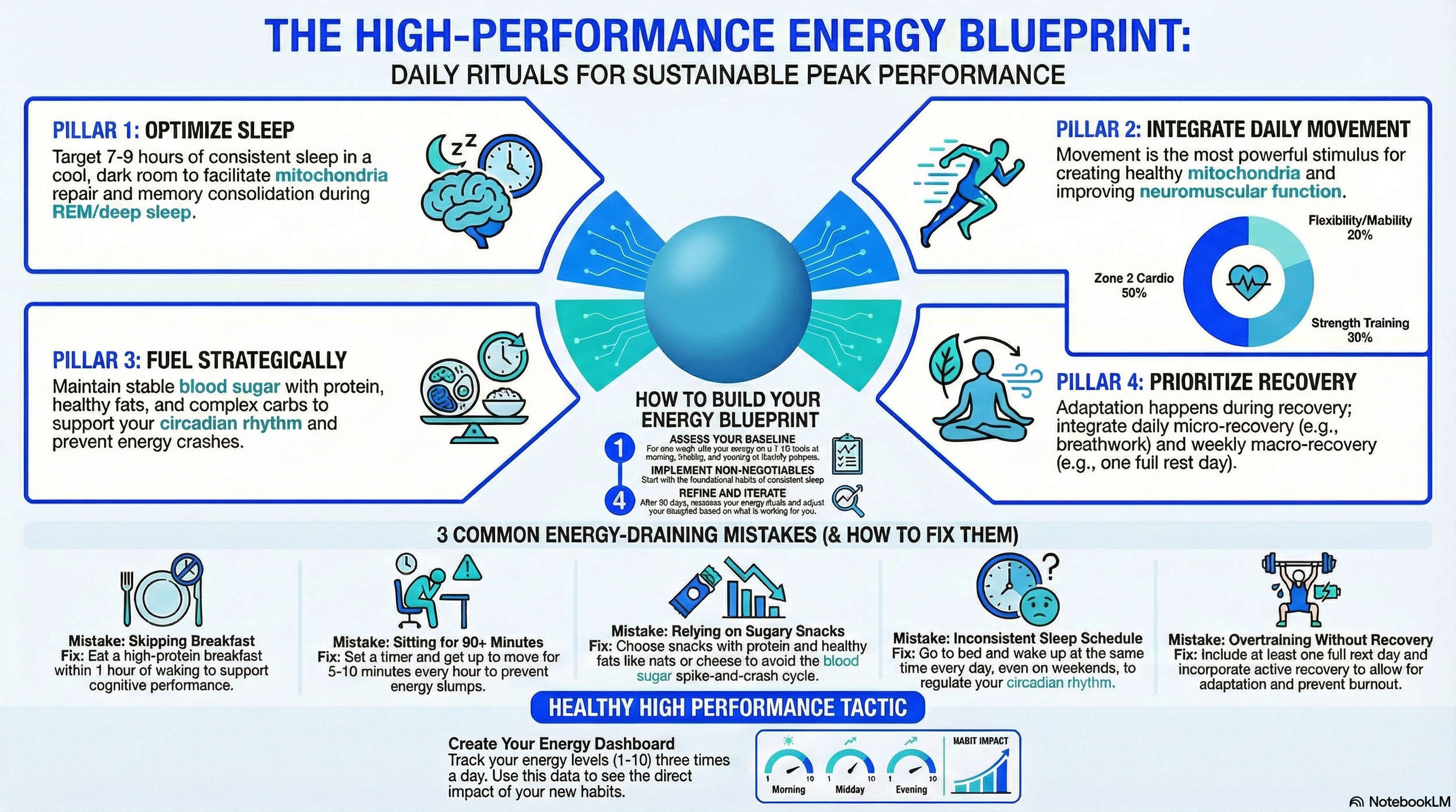
Everything begins here. Your mitochondria repair and regenerate during sleep. Memory consolidation happens during REM and deep sleep phases, and sleep deprivation impairs the brain's ability to retain information [1], [2], [3]. Target 7 to 9 hours consistently. Studies show that irregular sleep schedules increase mortality risk by 20 to 48 percent, independent of total hours slept [4].
Keep your bedroom cool (19°C), dark, and quiet. Defend the last hour before bed: no screens, lower lights. When sleep is optimized, everything else becomes easier.
Pillar 2: Daily Movement as a Natural Energy Booster (Energy In, Energy Out)
Movement is the most powerful stimulus for creating healthy mitochondria. Aim for 30 minutes daily via movement "snacks" (stairs, post-meal walks, desk squats) plus dedicated workouts.
A balanced approach includes Zone 2 cardio (about 50% of your training), which builds your aerobic base and enhances metabolic flexibility; strength training (30%), which research shows improves neuromuscular function with as little as one session per week; and flexibility or mobility work (20%), including yoga, stretching, or tai chi.
Every 60 to 90 minutes, take 5 to 10 minutes for movement. This aligns with your natural energy cycles and prevents the afternoon slump.
Pillar 3: Nutrition for Sustained Energy Levels Throughout the Day (Strategic Fueling)
Food is medicine and your most direct lever to boost energy naturally. Stable blood sugar throughout the day means sustained focus, mood, and peak performance. Breakfast matters significantly for cognitive performance, particularly in preventing afternoon crashes. Include protein, healthy fats, and complex carbohydrates.
For lunch, emphasize vegetables, lean protein, and whole grains. Avoid refined carbohydrates that spike blood sugar and cause energy crashes.
For snacks, choose nuts, berries, vegetables with hummus, or a small amount of dark chocolate. Consistent eating windows support your circadian rhythm and digestive health.
Pillar 4: Recovery Rituals to Build Your Energy Reserves (The Often-Forgotten Secret)
Recovery is where adaptation happens. Without it, you're just breaking yourself down. Structure recovery at three levels:
1. Daily micro-recovery: Breathwork (try the 2-4-6 technique: inhale for 2, hold for 4, exhale for 6), spend time in nature, or do 5 to 10 minutes of meditation.
2. Weekly macro-recovery: One full day of rest with no intense exercise, perhaps a sauna or cold plunge session, and reduced technology use.
3. Monthly deep recovery: One full weekend disconnected from work and technology. Research shows strategic rest improves year-end performance ratings and prevents burnout.
How to Build Your Personal Energy Blueprint
Creating lasting change requires a systematic approach:
Step 1: Assess your current state. Rate your energy levels (1 to 10) at morning, midday, and evening for one week. Notice patterns.
Step 2: Implement non-negotiables first. Start with sleep consistency and daily movement. These form your foundation.
Step 3: Layer in optimization tools. Add breathwork before high-stakes moments, recovery rituals after intense periods, and nutritional adjustments based on your schedule.
Step 4: Refine based on results. After 30 days, reassess. What's working? What needs adjustment? Small iterations lead to sustainable transformation.
5 Energy Mistakes That Drain Your Reserves (And How to Fix Them)
· Skipping breakfast: Adolescents and adults who skip breakfast show impaired cognitive performance and make poorer food choices throughout the day [5], [6]. Plus, skipping breakfast is associated with higher cardiovascular risks. Make sure you eat a high protein breakfast with some complex carbs within 1 hour of waking to kickstart your day.
· Sitting for 90+ minutes without movement: Prolonged sitting drains energy and impairs focus. Set a timer and move every hour.
· Sugary snacks: The spike-and-crash cycle depletes your reserves and triggers more cravings. Have some mixed nuts, some cheese, a hard-boiled egg, or some apple slices with nut butter instead.
· Sacrificing sleep: No amount of optimization can compensate for chronic sleep deprivation. Make sure you are getting 7-9 hours per night.
· All-or-nothing thinking: Progress, not perfection, is the goal. Missing one day doesn't mean failure. Just start again tomorrow.
Why Building an Energy Reserve Matters for Long-Term Performance
Think of your energy like a bank account. Every day, you make deposits through sleep, movement, nutrition, and recovery. Every day, you make withdrawals through work, stress, and life's demands. Most people live paycheck to paycheck energetically, constantly depleted and reactive.
When you optimize the four pillars—sleep, movement, nutrition, and recovery—you build reserves. This buffer doesn't just help you feel better today. It sustains you when challenges inevitably arrive: a crisis at work, a health scare, a family emergency. People with energy reserves don't just survive these moments. They navigate them with clarity, resilience, and grace.
The rituals you build now are an investment in your future self.
1% TIP: CREATE YOUR ENERGY DASHBOARD
Track your energy levels throughout the day using a simple 1 to 10 scale at three points: morning, afternoon, and evening. After a week of baseline data, implement one change and observe the difference. The goal isn't perfect energy at all times. It's consistent energy for your peak moments, the presentations, the creative work, the time with family that matters most.
Your body has extraordinary capacity to adapt, heal, and perform. Give it the right inputs through daily rituals, and it will reward you with the sustained energy to live a life of health, wellbeing, and impact.
References
[1] W. Li, L. Ma, G. Yang, and W.-B. Gan, “REM sleep selectively prunes and maintains new synapses in development and learning.,” Nat. Neurosci., vol. 20, no. 3, pp. 427–437, Mar. 2017, doi: 10.1038/nn.4479.
[2] N. D. Lutz, M. Harkotte, and J. Born, “Sleep’s contribution to memory formation.,” Physiol. Rev., vol. 106, no. 1, pp. 363–483, Jan. 2026, doi: 10.1152/physrev.00054.2024.
[3] P. Meerlo, R. E. Mistlberger, B. L. Jacobs, H. C. Heller, and D. McGinty, “New neurons in the adult brain: the role of sleep and consequences of sleep loss.,” Sleep Med. Rev., vol. 13, no. 3, pp. 187–194, Jun. 2009, doi: 10.1016/j.smrv.2008.07.004.
[4] D. P. Windred et al., “Sleep regularity is a stronger predictor of mortality risk than sleep duration: A prospective cohort study,” Sleep, vol. 47, no. 1, p. zsad253, Jan. 2024, doi: 10.1093/sleep/zsad253.
[5] S.-H. Cheng and L. Q. Rebecca Yew, “Breakfast Skipping: Influencing Factors and its Impact on Cognitive Function and Academic Performance among Malaysian University Students.,” Percept. Mot. Skills, vol. 132, no. 5, pp. 829–850, Oct. 2025, doi: 10.1177/00315125251329999.
[6] C. Michaud, N. Musse, J. P. Nicolas, and L. Mejean, “Effects of breakfast-size on short-term memory, concentration, mood and blood glucose,” J. Adolesc. Heal., vol. 12, no. 1, pp. 53–57, 1991, doi: https://doi.org/10.1016/0197-0070(91)90042-K.