
Episode 21 · July 2, 2021 · 45 min



When Ireland’s economy crashed, about 10 years before we spoke, Dr. Mark Rowe’s waiting room filled with people who had lost their jobs and were afraid of losing their homes. As a family physician, he could see they needed more than a prescription, and that pushed him toward lifestyle medicine: using exercise, nutrition, sleep, stress management and relationships to prevent and treat chronic disease. He is clear that we will always need medication and skilled surgeons. His point is that the more you focus on lifestyle, the less you will need the other two. After 25 years in practice, he has also found that most people already know what to do. What they struggle with is building the habit.
Sleep is where I see this most clearly in my own life. I tracked my sleep for a while and experimented. On a night when I checked email right up until bed, I got 17 minutes of deep sleep, when I normally get about an hour and a half. Research from Anne-Marie Chang, Charles Czeisler and their colleagues shows how much screens before bed can cost you. People who read on a light-emitting tablet before bed took longer to fall asleep, released less melatonin, had a later circadian clock and were less alert the next morning than when they read a printed book. When your eyes take in that bright, blue-rich light late in the evening, your brain treats it as daytime and delays the signals that prepare you for sleep. Now I use the bedtime alarm on my phone so I am in bed when I planned to be.
“We can be perfect with our imperfections.”
Key takeaways
Start with one habit. Pick one change, like a daily walk or an earlier bedtime, and stay with it until it feels automatic. In one well-known study, that took people an average of 66 days.
Set a bedtime alarm. An alarm that tells you when to go to bed protects the sleep that makes the early alarm possible.
Put screens away before bed. Light from a phone or tablet late at night delays melatonin and makes it harder to fall asleep.
Feed your gut. Fill your plate with colourful, fibre-rich vegetables and add fermented foods like yogurt and kefir.
Keep a journal. Write down which days went well and why. Reflection shows you what to repeat next week.
Your 1% Tip
Tonight, set a bedtime alarm for 30 minutes before you want to be asleep, and put your phone away when it goes off.
About Mark
Dr. Mark Rowe is a family physician who founded Waterford Health Park in Ireland, home to his medical practice and its lifestyle medicine clinic. He is the author of A Prescription for Happiness and Things Your Future Self Will Thank You For, and he speaks internationally on lifestyle as medicine.
Resources
drmarkrowe.com: Mark’s clinic, books and talks.
Chang et al., 2015: evening use of light-emitting eReaders and sleep, published in PNAS.
Lally et al., 2010: how habits are formed in the real world, published in the European Journal of Social Psychology.
Get the science in your inbox
Wells Performance Insights is my newsletter. I take the science of your body and brain and turn it into a 1% Tip you can use the same day. Sign up for Wells Performance Insights.
The book
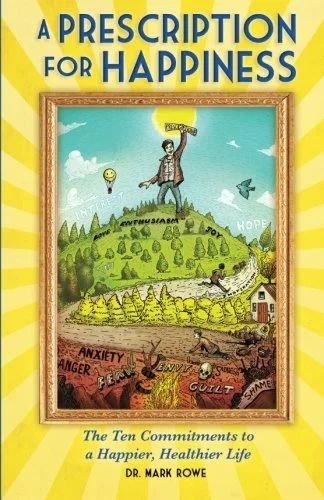
Mark’s first book, A Prescription for Happiness, sets out ten commitments for a happier, healthier life. His newest, Things Your Future Self Will Thank You For, is about small changes with lasting results. Find the book.
Dr. Greg Wells is a human physiologist, five-time bestselling author, Senior Scientist Emeritus at SickKids and author of 70+ peer-reviewed papers.
This podcast contains advice and information relating to health and wellness. It should be used to supplement rather than replace the advice of your doctor or another trained health professional. If you know or suspect that you have a health problem, seek your physician’s advice before embarking on any medical program or treatment. All efforts have been made to assure the accuracy of the information contained in this podcast / interview / article as of the date of publication. The author and publisher disclaim liability for any medical or other outcomes that may occur as a result of applying the methods suggested in this material.
