Move to Create: Walking, Empathy, and the Art of Collaborative Genius
Creativity is your irreplaceable human edge, and solitude unlocks the mental space where original ideas can emerge. Now let's explore how movement—especially walking—amplifies your creative capacity, and how empathy transforms groups of individuals into collaborative problem-solving teams.
How Walking Boosts Creativity: The Science
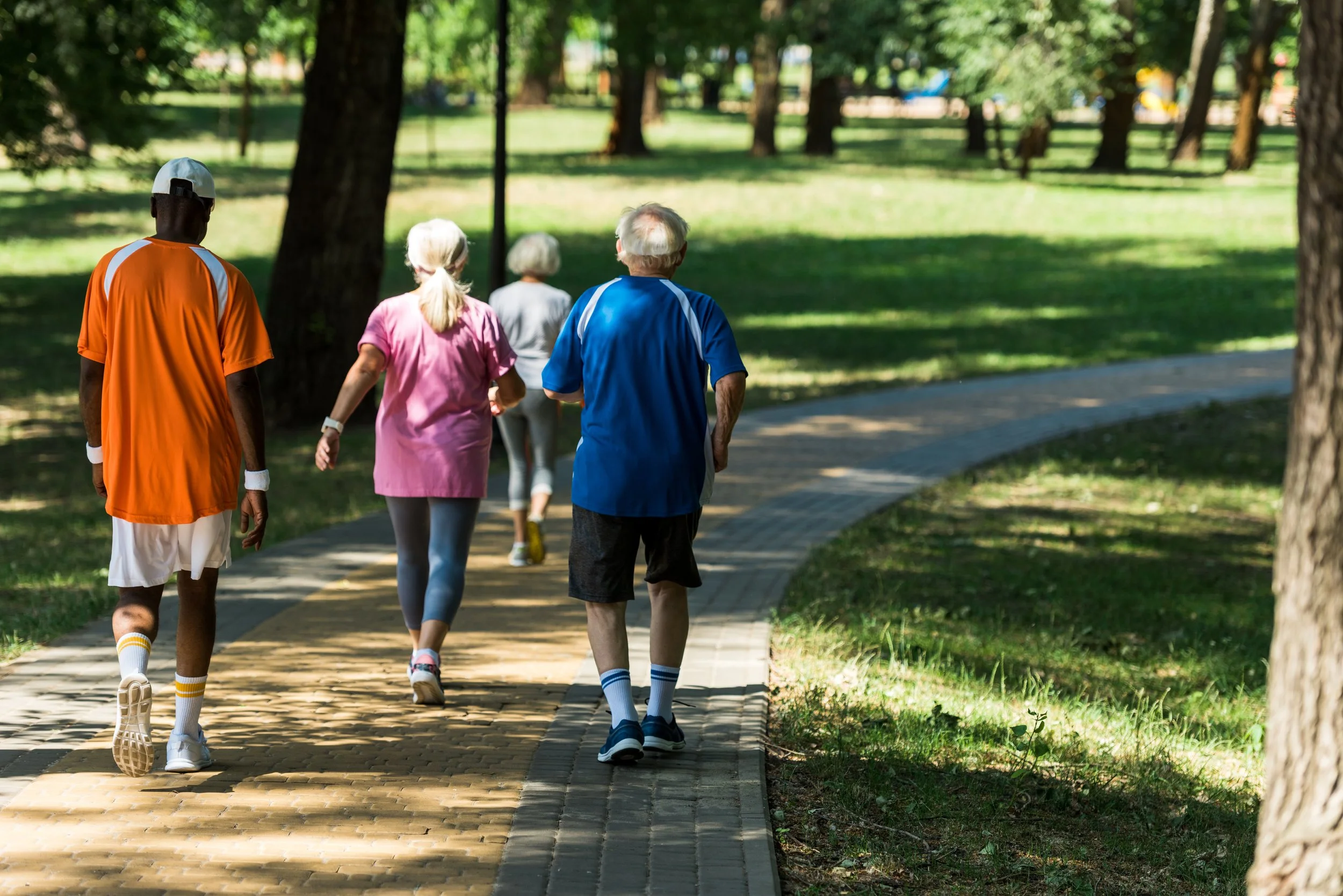
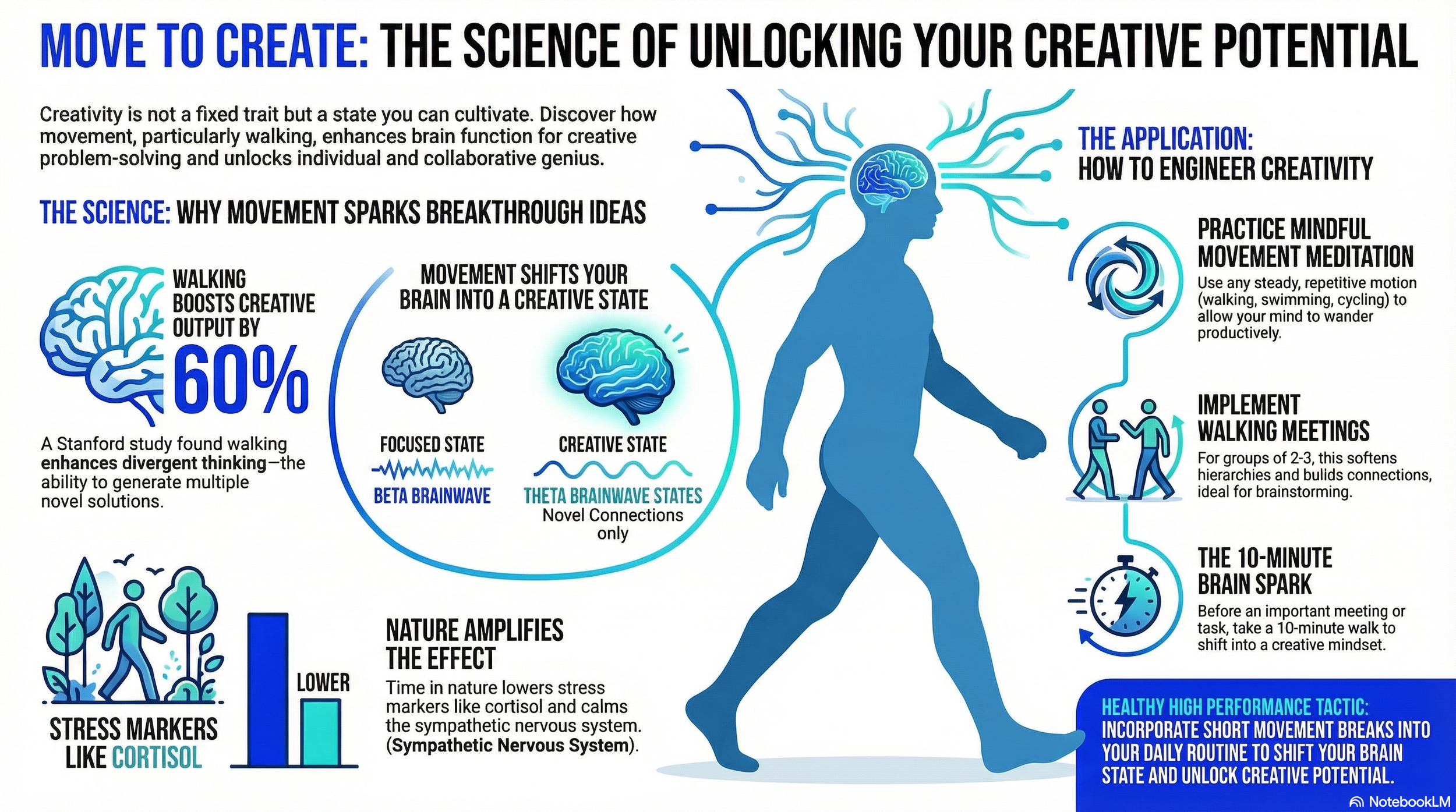
In a landmark study published in the Journal of Experimental Psychology, found that walking increases creative output by approximately 60% compared to sitting. The effect held whether participants walked on a treadmill facing a blank wall or strolled outdoors—walking itself, not the scenery, was the primary driver [1].
Across four experiments, 81% to 100% of participants generated more creative ideas while walking. The boost was specific to divergent thinking—the type of thinking that generates multiple novel solutions—rather than convergent thinking, which narrows toward a single correct answer [1]. Perhaps most valuable for real-world application: the creative boost persists even after you sit back down. Walking before a brainstorming session, a big meeting, or a difficult decision primes your brain for the creative work ahead.
Why Walking and Rhythmic Movement Boost Creativity
Rhythmic movement shifts your brain from beta (alert, task-focused) into theta brainwave states, where creativity flourishes. As I mentioned in my last article, theta oscillations prime your brain to form novel connections.
Moderate physical activity also stimulates just the right amount of arousal to enhance cognitive function without tipping into stress. Research shows that exercise at moderate intensity (you should still be able to hold a conversations) optimizes prefrontal cortex activation and improves learning, memory, and creative problem-solving [2].
Nature amplifies these effects. Studies on shinrin-yoku (forest bathing) demonstrate that spending time in natural environments reduces cortisol, lowers sympathetic nervous system activity, and significantly decreases symptoms of anxiety, depression, and mental fatigue [3], [4]. This relaxed-but-alert state is precisely where creative insight thrives.
Mindful Movement Meditation for Creativity
Movement meditation combines mindful, rhythmic activity with open awareness, allowing you to stay present while your mind makes unexpected connections. Walking, cycling, swimming, paddling, yoga—any steady, repetitive motion can serve as moving meditation.
The key is rhythm without strain. Move at an intensity where you can hear your breathing but still hold a conversation. Let your mind wander without forcing it toward any particular outcome. Over time, this practice trains your brain to enter creative states more easily.
Empathy: The Secret Ingredient of Collaborative Creativity and Innovation
Individual creativity is powerful, but complex problems increasingly require collaborative intelligence. Empathy is the catalyst that transforms a group of individuals into a true creative team.
Empathy engages brain regions associated with imagination, enabling people to think beyond their own experiences and envision alternative outcomes. Studies on creative problem-solving in groups demonstrate that caring about the outcome for others significantly predicts all dimensions of creativity: fluency, flexibility, originality, and usefulness [5].
Practice "Yes, and..." thinking: instead of immediately critiquing others' ideas, build on them. Actively listen. Ask questions that show genuine curiosity about someone else's perspective. These small habits shift group dynamics from defensive to generative.
Walking Meetings: Where Movement, Empathy and Collaboration Converge
A colleague once described how the director of a research lab she worked in would take the entire team for a walk after lunch every day. What seemed like a simple ritual transformed the culture: conversations flowed more naturally, hierarchies softened, and connections between team members deepened, leading to collaborative problem-solving that had been difficult to achieve in conference rooms.
Research confirms that walking meetings boost creativity, improve focus, and build connection. Stanford research found that walking together creates a more relaxed, informal atmosphere where people feel comfortable sharing ideas and opinions [1].
Walking meetings work best for brainstorming, problem-solving, and relationship-building. Keep groups small (two to three people), give advance notice so colleagues can dress appropriately, and leave devices behind.
Your Creative Trifecta: Solitude, Movement, and Empathy
In these last three articles, we’ve traced a path from understanding why creativity is your irreplaceable human edge, through the power of solitude and stillness to unlock it, to movement and empathy as tools for both individual insight and collaborative genius. The throughline is clear: creativity is not a fixed trait but a state you can cultivate. By protecting time for solitude, incorporating rhythmic movement, and deepening empathy in your collaborations, you build the conditions where your best ideas—and your team's best work—can emerge.
1% TIP: USE MOVEMENT TO SPARK YOUR BRAIN
Give your brain energy by weaving short bursts of movement throughout your day. Before an important meeting, take a 10-minute walk. When you feel stuck on a problem, step away from your desk and move. Even a few minutes of rhythmic activity can shift your brain from execution mode to creative mode. Build the habit, and you'll find that movement becomes one of your most reliable tools for unlocking fresh ideas.
References
[1] M. Oppezzo and D. L. Schwartz, “Give your ideas some legs: the positive effect of walking on creative thinking.,” J. Exp. Psychol. Learn. Mem. Cogn., vol. 40, no. 4, pp. 1142–1152, Jul. 2014, doi: 10.1037/a0036577.
[2] R. Kaplan et al., “Movement-Related Theta Rhythm in Humans: Coordinating Self-Directed Hippocampal Learning,” PLOS Biol., vol. 10, no. 2, p. e1001267, Feb. 2012, [Online]. Available: https://doi.org/10.1371/journal.pbio.1001267
[3] Q. Li, “Effects of forest environment (Shinrin-yoku/Forest bathing) on health promotion and disease prevention -the Establishment of ‘Forest Medicine’.,” Environ. Health Prev. Med., vol. 27, p. 43, 2022, doi: 10.1265/ehpm.22-00160.
[4] L. Queirolo et al., “Effects of forest bathing (Shinrin-yoku) in stressed people,” Front. Psychol., vol. Volume 15, 2024, [Online]. Available: https://www.frontiersin.org/journals/psychology/articles/10.3389/fpsyg.2024.1458418
[5] A. M. Grant and J. W. Berry, “The necessity of others is the mother of invention: Intrinsic and prosocial motivations, perspective taking, and creativity.,” 2011, Academy of Management, Grant, Adam M.: grantad@wharton.upenn.edu. doi: 10.5465/AMJ.2011.59215085.