
Episode 41 · November 19, 2021 · 40 min



When I was 15, I broke my neck swimming. I was flown to Toronto for surgery on C3 and C4, and right after the operation my surgeon told me I would never swim again. Something inside me rejected that instantly. Chris Norton had the same reaction. He broke his neck during a college football game in 2010, and after surgery he was told he had a 3% chance of regaining any feeling or movement below the neck. On day one, the only thing he could do was nod his head, so he nodded for hours.
Chris and his dad agreed to do all the little things right every day, and when a doctor told him he would never move his legs, his dad told him not to let anyone tell him what he could or could not do. A week later Chris wiggled his left big toe. Back at college he set a public goal to walk across the stage at his graduation, trained for years and did it with Emily, now his wife, at his side. Goal-setting research explains part of that pull. In their review of 35 years of studies, Edwin Locke and Gary Latham found that specific, difficult goals consistently led to better performance than vague goals such as “do your best.” When you commit to a clear, hard target, you direct your attention to it, work harder and longer, and search for the strategies that will get you there.
“My future will take care of itself when I take care of today.”
Key takeaways
Take care of today. Chris’s rule was to do all the little things right every day and let the future take care of itself.
Let a hard prognosis fuel your effort. Chris heard a 3% chance and responded by doing more than his scheduled therapy every single day.
Set a big, specific goal and say it out loud. Telling people he would walk at graduation gave Chris accountability and a clear target to train for.
Celebrate the small wins. One wiggle of one toe was proof that progress was possible and fuel for the next step.
Turn your story outward. Chris’s foundation helps other people with spinal cord injuries get access to rehab and to camps that lift them up.
Your 1% Tip
Write down one specific, challenging goal for the next 90 days and tell one person about it today.
About Chris
Chris Norton is a keynote speaker, author and founder of the Chris Norton Foundation, which helps people with spinal cord and neuromuscular disabilities live life to the fullest. He suffered a spinal cord injury during a college football game in 2010 at age 18. He and his wife, Emily, wrote The Seven Longest Yards, and their story is told in the documentary 7 Yards.
Resources
chrisnorton.org: Chris’s official website, with his foundation, book and film.
Locke and Latham, 2002: 35 years of goal-setting research, published in the American Psychologist.
Get the science in your inbox
Wells Performance Insights is my newsletter. I take the science of your body and brain and turn it into a 1% Tip you can use the same day. Sign up for Wells Performance Insights.
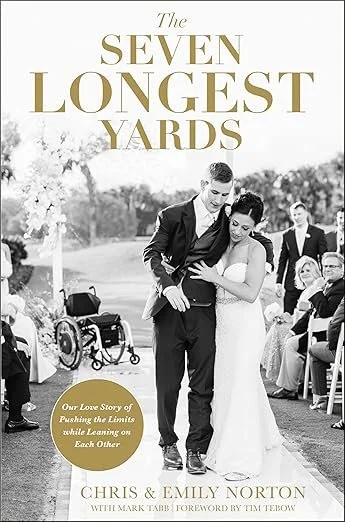
The book
The Seven Longest Yards is the story Chris and Emily Norton wrote together about his recovery and the walk they took side by side. Find the book.
Dr. Greg Wells is a human physiologist, five-time bestselling author, Senior Scientist Emeritus at SickKids and author of 70+ peer-reviewed papers.
This podcast contains advice and information relating to health and wellness. It should be used to supplement rather than replace the advice of your doctor or another trained health professional. If you know or suspect that you have a health problem, seek your physician’s advice before embarking on any medical program or treatment. All efforts have been made to assure the accuracy of the information contained in this podcast / interview / article as of the date of publication. The author and publisher disclaim liability for any medical or other outcomes that may occur as a result of applying the methods suggested in this material.
