
Episode 47 · December 31, 2021 · 40 min



During my postdoc at the Hospital for Sick Children in Toronto, I worked largely in cystic fibrosis, and I saw young people before and after lung transplants. How differently they could breathe and move afterward still amazes me. Mark Black was born with a serious heart defect and received a heart and double lung transplant as a young adult. Before he was listed, his medical team told him that if everything went well, he could expect to go back to work part time someday. Mark decided he had not gone through all of that to live small. He started rehab with a one-pound dumbbell, then worked up to a 5K, a 10K, a half marathon on his 26th birthday and, eventually, four marathons.
Mark now teaches a five-step loop: accept, aim, adapt, act and assess. The step he leans on most is choosing what events mean, because the meaning you assign shapes how you respond. Research on stress shows how deep that goes. When Jeremy Jamieson’s team at Harvard taught people to see the racing heart and quick breathing of a stressful speaking test as fuel for performance, their hearts pumped blood more efficiently, their blood vessels relaxed and they were less distracted by threatening information. When you reinterpret your stress response as preparation, you move your body toward a challenge state, which gives you more resources to act.
“You get to decide what the events in your life mean.”
Key takeaways
Accept, then aim. Tell the truth about where you are, then picture a better tomorrow, however small the first step.
Build up in stages. Mark went from a one-pound dumbbell to a 5K, a 10K, a half marathon and then a marathon. Each win set up the next one.
Choose the meaning. You do not choose everything that happens to you, but you decide what it means and how you respond.
Ask whether your story serves you. You may be justified in calling something unfair. The more useful question is whether that story moves you toward the person you want to become.
Assess and adapt. Stop regularly to ask whether what you are doing is working, and change course when it is not.
Your 1% Tip
Pick one setback you are carrying. Write down the meaning you have given it, then write one alternative meaning that moves you forward, and take one action on it today.
About Mark
Mark Black is a keynote speaker, author and coach. Born with a serious heart defect, he received a heart and double lung transplant and went on to run four marathons. He has spoken to more than 150,000 people at over 700 organizations, and his latest book is The Resilience Roadmap: 7 Guideposts for Charting Your Course in a Chaotic World.
Resources
markblack.ca: Mark’s official website.
The Resilience Roadmap: Mark’s book.
Jamieson et al., 2012: reappraising stress arousal, published in the Journal of Experimental Psychology: General.
Get the science in your inbox
Wells Performance Insights is my newsletter. I take the science of your body and brain and turn it into a 1% Tip you can use the same day. Sign up for Wells Performance Insights.
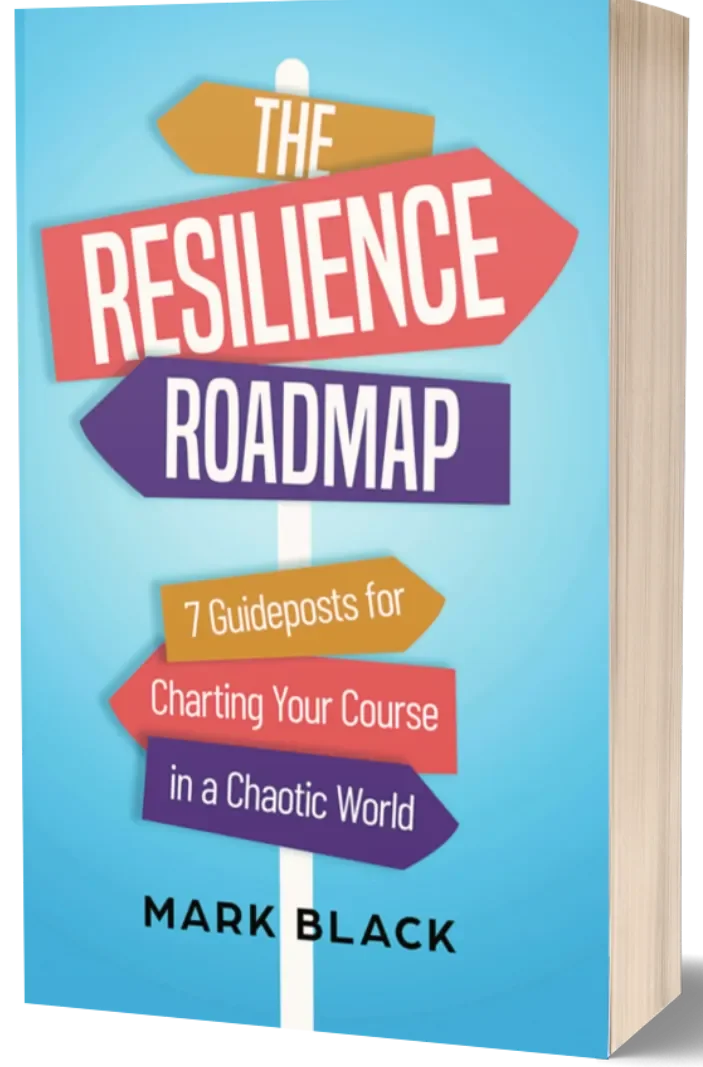
The book
The Resilience Roadmap: 7 Guideposts for Charting Your Course in a Chaotic World is Mark’s guide to moving forward when life changes without your permission. Find the book.
Dr. Greg Wells is a human physiologist, five-time bestselling author, Senior Scientist Emeritus at SickKids and author of 70+ peer-reviewed papers.
This podcast contains advice and information relating to health and wellness. It should be used to supplement rather than replace the advice of your doctor or another trained health professional. If you know or suspect that you have a health problem, seek your physician’s advice before embarking on any medical program or treatment. All efforts have been made to assure the accuracy of the information contained in this podcast / interview / article as of the date of publication. The author and publisher disclaim liability for any medical or other outcomes that may occur as a result of applying the methods suggested in this material.
