
Episode 263 · April 3, 2026 · 40 min



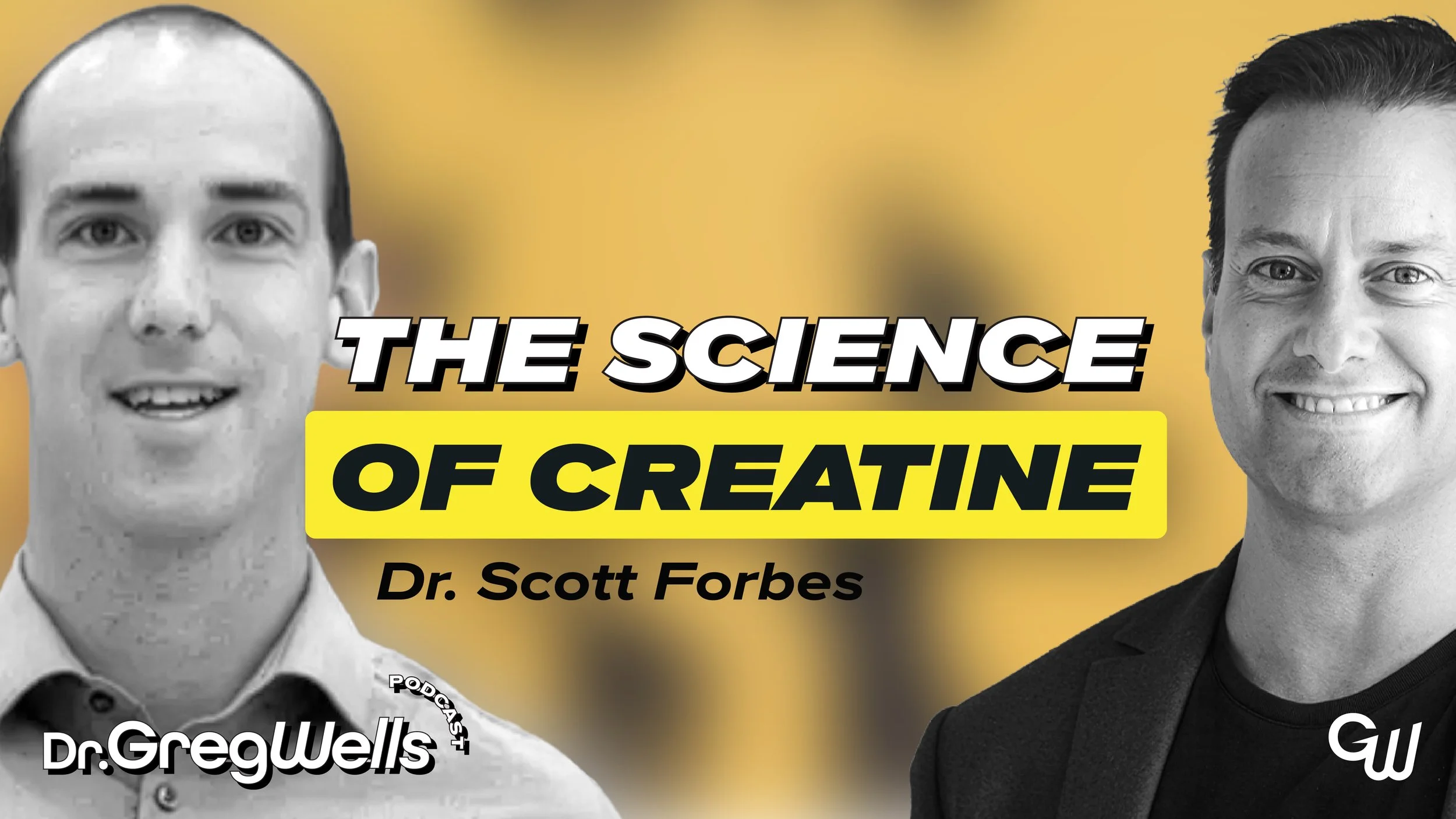
About 20 years ago I worked with a teenage athlete who was struggling for a whole range of reasons. We started her on a small daily dose of creatine, four to six grams, and it helped bring her athletics back to life. Creatine has since exploded on social media, and with that much attention comes a lot of hype, so I asked Dr. Scott Forbes to sort the evidence from the noise. Scott is a professor and Chair of Physical Education Studies at Brandon University, and his more than 110 peer-reviewed papers focus on creatine, resistance training and healthy aging.
As a physiologist, I love how simple the mechanism is. About 95% of the creatine in your body is stored in your muscle, where it fuels the phosphocreatine system you rely on for short, explosive efforts. When you supplement, you expand that system by about 20%, which might stretch 8 to 10 seconds of all-out work to 10 to 12. Scott explains how that small edge adds up over months of training and how to use creatine safely.
“Creatine is not a steroid.”
Key takeaways
Expect a small edge that compounds. In Scott’s meta-analysis of creatine combined with resistance training, muscle thickness increased by about 1 millimetre on average, in both the upper and lower body. One or two extra reps per set is a small effect, and over time it adds up to bigger, stronger muscle.
Use it as a short-term bridge for your brain. Your brain is about 2% of your body mass and uses about 20% of your daily energy. Studies Scott describes show creatine can blunt the drop in cognition after sleep deprivation and help you hold performance through 90 minutes of demanding mental work. It supports you through a hard stretch and never replaces sleep.
Protect strength as you age. Scott’s 2024 systematic review and meta-analysis in older adults found gains in lean mass and upper body strength when creatine was combined with strength training, and about half of a typical 1.1 to 1.3 kg lean mass gain is muscle. Creatine can also improve sit-to-stand performance, a practical marker of daily function.
Know what the research says about the myths. Creatine is an energy molecule built from three amino acids. In a 12-week trial Scott worked on with colleagues, 5 grams a day had no effect on direct measures of hair health. Because creatine raises creatinine in your blood, ask your doctor about cystatin C, or creatinine measured in both blood and urine, when you want to assess kidney function.
Keep it simple. Choose creatine monohydrate, the form used in about 95% of the 685 randomized controlled trials in a recent safety review, and take 3 to 5 grams a day. Taking it before or after training made no difference in Scott’s studies, and taking it only on training days still worked for muscle.
Your 1% Tip
If creatine fits your goals, put a tub of creatine monohydrate beside your coffee maker and take 5 grams at the same time every morning. That is what I do, because it sits right there on the counter. When you anchor a new habit to one you already have, you stop relying on memory to make it happen.
About Scott
Dr. Scott Forbes is a professor and Chair of the Department of Physical Education Studies at Brandon University in Manitoba. He completed his PhD in exercise physiology at the University of Alberta and post-doctoral research at the University of Calgary. He is a Certified Exercise Physiologist and High Performance Specialist with the Canadian Society for Exercise Physiology, a Certified Sports Nutritionist and Fellow of the International Society of Sports Nutrition, and a core member of the Creatine for Health initiative. His research looks at how creatine and protein support muscle, bone and brain health in athletes and older adults.
Resources
Creatine and strength training in older adults: Scott’s 2024 updated meta-analysis on lean mass, strength and bone.
Creatine and regional muscle hypertrophy: the 2023 systematic review with meta-analysis on muscle thickness, which Scott co-authored.
Get the science in your inbox
Wells Performance Insights is my newsletter. I take the science of your body and brain and turn it into a 1% Tip you can use the same day. Sign up for Wells Performance Insights.
Dr. Greg Wells is a human physiologist, five-time bestselling author, Senior Scientist Emeritus at SickKids and author of 70+ peer-reviewed papers.
This podcast contains advice and information relating to health and wellness. It should be used to supplement rather than replace the advice of your doctor or another trained health professional. If you know or suspect that you have a health problem, seek your physician’s advice before embarking on any medical program or treatment. All efforts have been made to assure the accuracy of the information contained in this podcast / interview / article as of the date of publication. The author and publisher disclaim liability for any medical or other outcomes that may occur as a result of applying the methods suggested in this material.
