
Episode 269 · June 26, 2026 · 98 min


On a walking safari in South Africa, I climbed onto a mound of earth and found myself face to face with a rhinoceros. We both froze, its ears locked onto me, and I took one photo before my guide moved us out of there. That night, flipping through my shots, I realized I had completely missed the second rhino standing right beside it, and the green parrots in the tree above. This masterclass, recorded live at a dental conference, explains why that happens and what you can do about it.
When you sense a threat, your amygdala switches on your stress response, your focus locks onto the danger and you lose your peripheral vision, and with it your peripheral thinking. When you calm down, your vision and your options open up again. In this session, built on my books Rest, Refocus, Recharge and Powerhouse, I walk through the brainwave states you move through each day and the practices that help you shift between them.
“Remember, calm is your superpower.”
Key takeaways
Complete the infinity loop. Healthy high performance follows a loop: perform at your best, then rest deeply to return to balance before you perform again. The rest is the step most of us skip, and doom scrolling through the news does not count as recovery.
Take some long slow distance. Creative insight tends to arrive in a theta brainwave state, which you can reach through rhythmic, repetitive movement such as walking, running, swimming, cycling or paddling, ideally without your phone. Pair it with solitude: an open block of time, alone or with the person you are creating with.
Steer your state with your breath. A long, slow exhale calms the breathing centres in your brainstem, which sit close to the regions that drive your stress response. In a hard moment, breathe in, take an extra short sip of air at the top, then exhale slowly. For a long stressful stretch, try box breathing: in for four, hold for four, out for four, hold for four.
Protect your attention. Uninstall the social media apps from your phone, turn off audio notifications and check your screen time numbers. Where your attention goes, your energy flows, so direct it toward the people and practices you care about instead of where the algorithm wants it.
Build your people, places and pursuits. Strong social connections are associated with lower mortality, on a par with quitting smoking. Name your dream team, the three to five people in your personal life who elevate you, and your brain trust, the three to five people who do the same at work, then spend more time with them and more time in nature.
Your 1% Tip
The next time you feel stress rising, breathe in through your nose, take one extra short sip of air at the top, then let it all out in a long, slow exhale. Do it two or three times. When you lengthen the exhale, you settle your nervous system and make room for your peripheral thinking again.
About this episode
This masterclass was recorded live at the Ontario Dental Association and combines my book Rest, Refocus, Recharge with the most popular ideas from Powerhouse. It pairs with The Ripple Effect Masterclass (Episode 272), which covers sleep, nutrition, movement and mindset.
Resources
Rest, Refocus, Recharge by Dr. Greg Wells: my guide to recovery, focus and the brainwave states behind them.
Powerhouse by Dr. Greg Wells: how to protect your energy and build your capacity.
Get the science in your inbox
Wells Performance Insights is my newsletter. I take the science of your body and brain and turn it into a 1% Tip you can use the same day. Sign up for Wells Performance Insights.
The book
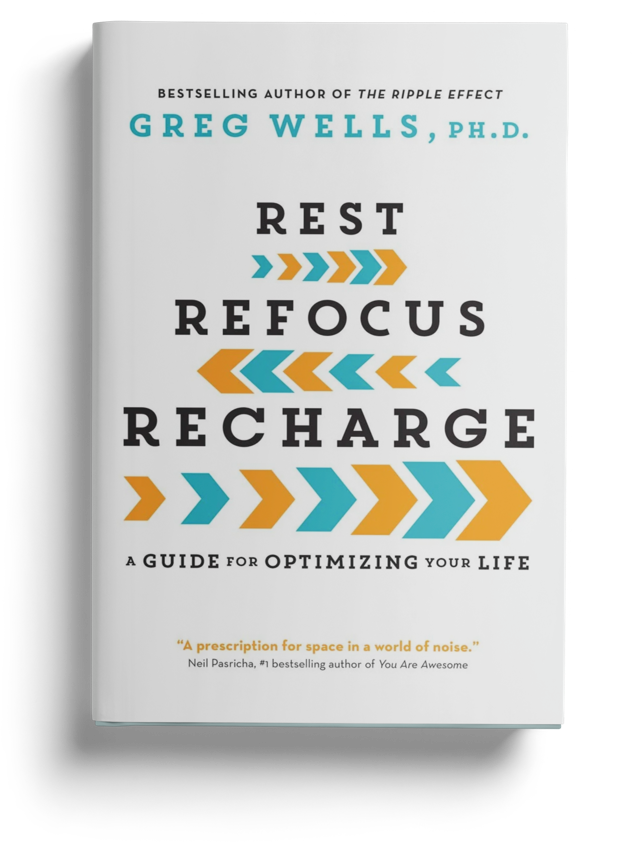
Rest, Refocus, Recharge: A Guide for Optimizing Your Life is my guide to how small changes in the way you rest, refocus and recharge can improve your mental health and help you perform at your best.
Dr. Greg Wells is a human physiologist, five-time bestselling author, Senior Scientist Emeritus at SickKids and author of 70+ peer-reviewed papers.
This podcast contains advice and information relating to health and wellness. It should be used to supplement rather than replace the advice of your doctor or another trained health professional. If you know or suspect that you have a health problem, seek your physician’s advice before embarking on any medical program or treatment. All efforts have been made to assure the accuracy of the information contained in this podcast / interview / article as of the date of publication. The author and publisher disclaim liability for any medical or other outcomes that may occur as a result of applying the methods suggested in this material.
