
Episode 2 · February 19, 2021 · 43 min



A personal trainer Dr. Brynn Winegard knows had clients who simply did not want to exercise, so he stopped asking them to run. He asked them to promise one thing instead. Every day, they would put on their workout clothes, tie their shoes, pull their hair back, put their earbuds in, walk out the front door and stand in the driveway. That was the whole commitment. Brynn loves the story because it captures what she teaches about motivation: starting is the hard part. Once you are dressed and standing in the driveway, the first step comes easily, and a little progress makes the next step easier still.
Brynn applies the same thinking to hard emotions. Rather than repress fear, she suggests you transform it: name it, normalize it and point its energy toward action. Researchers at Harvard tested a version of this with students preparing for the GRE. Students who were told that the physical arousal they feel before a test can help performance scored higher on the math section, both in a practice session and on the real exam one to three months later (Jamieson et al., 2010). Habits build one repetition at a time. In a study of 111 new gym members, it took at least four workouts a week for about six weeks before exercise became a habit, and doing it consistently was the strongest predictor of success (Kaushal and Rhodes, 2015).
“The secret to your happiness is to feel as though what you have is enough and who you are is enough.”
Key takeaways
Start anywhere. When you are stuck, make the first step tiny. A little progress motivates the next step, and the steps get bigger as you go.
Stop comparing. Brynn’s one-line answer to what makes people happy is to feel that what you have is enough and who you are is enough. Look back at how far you have come instead.
Turn fear into fuel. Name the feeling and put its energy to work. Brynn’s shorthand is to get mad instead of sad and ask what you can do differently.
Protect your workout time. Brynn exercises at the same time every day, blocked off in her calendar. On the days she misses it, her sleep, eating and focus all suffer.
Your 1% Tip
Tonight, set out your workout clothes. Tomorrow morning, put them on and walk out your front door. That is the whole commitment, so see where the next step takes you.
About Brynn
Dr. Brynn Winegard is an award-winning professor, speaker and expert in applied neuroscience and positive psychology for professionals. She studied neuroscience, psychology, marketing and strategy, earning a BSc, an MBA and a PhD, and spent more than a decade in corporate marketing with companies including Pfizer, Nestlé and Johnson & Johnson before teaching at the Schulich School of Business and the DeGroote School of Business.
Resources
Dr. Brynn Winegard: Brynn’s website, with her talks, writing and videos.
Jamieson et al., 2010: reappraising arousal improves performance on the GRE, published in the Journal of Experimental Social Psychology.
Kaushal and Rhodes, 2015: exercise habit formation in new gym members, published in the Journal of Behavioral Medicine.
Get the science in your inbox
Wells Performance Insights is my newsletter. I take the science of your body and brain and turn it into a 1% Tip you can use the same day. Sign up for Wells Performance Insights.
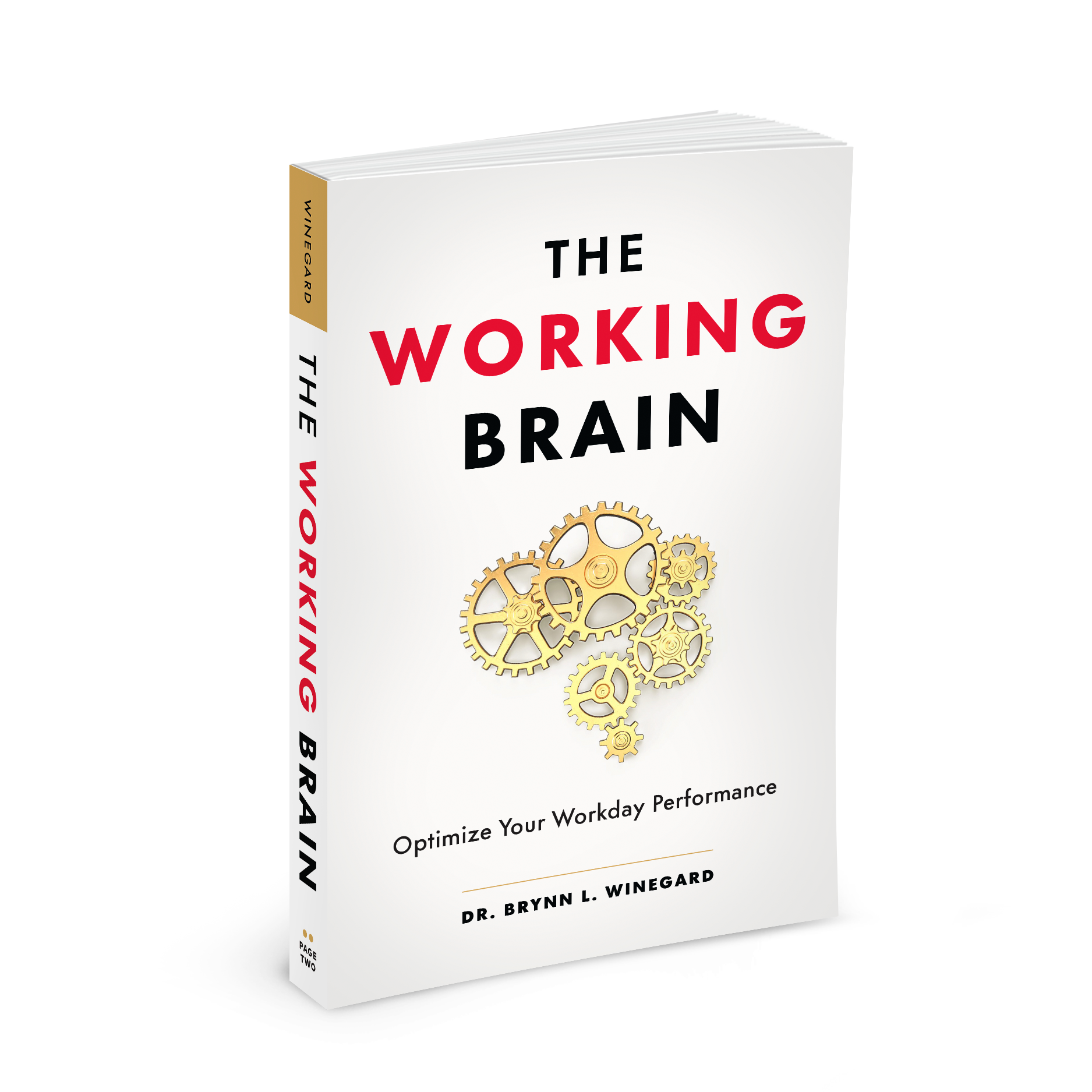
The book
In The Working Brain: Optimize Your Workday Performance, Brynn shares her MERIT Framework (Move, Eat, Rest, Interact, Think) for shaping your workday around how your brain works best. Find the book.
Dr. Greg Wells is a human physiologist, five-time bestselling author, Senior Scientist Emeritus at SickKids and author of 70+ peer-reviewed papers.
This podcast contains advice and information relating to health and wellness. It should be used to supplement rather than replace the advice of your doctor or another trained health professional. If you know or suspect that you have a health problem, seek your physician’s advice before embarking on any medical program or treatment. All efforts have been made to assure the accuracy of the information contained in this podcast / interview / article as of the date of publication. The author and publisher disclaim liability for any medical or other outcomes that may occur as a result of applying the methods suggested in this material.
